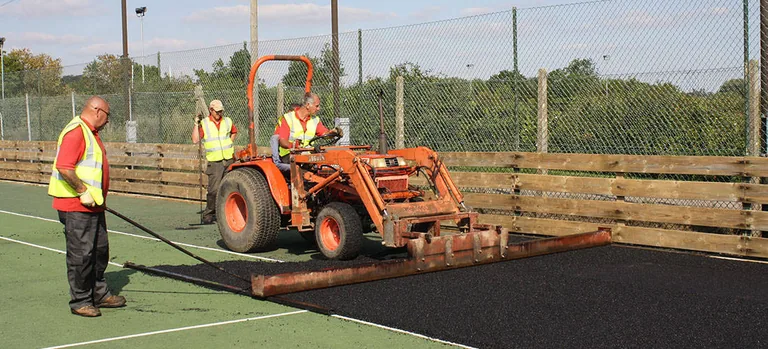
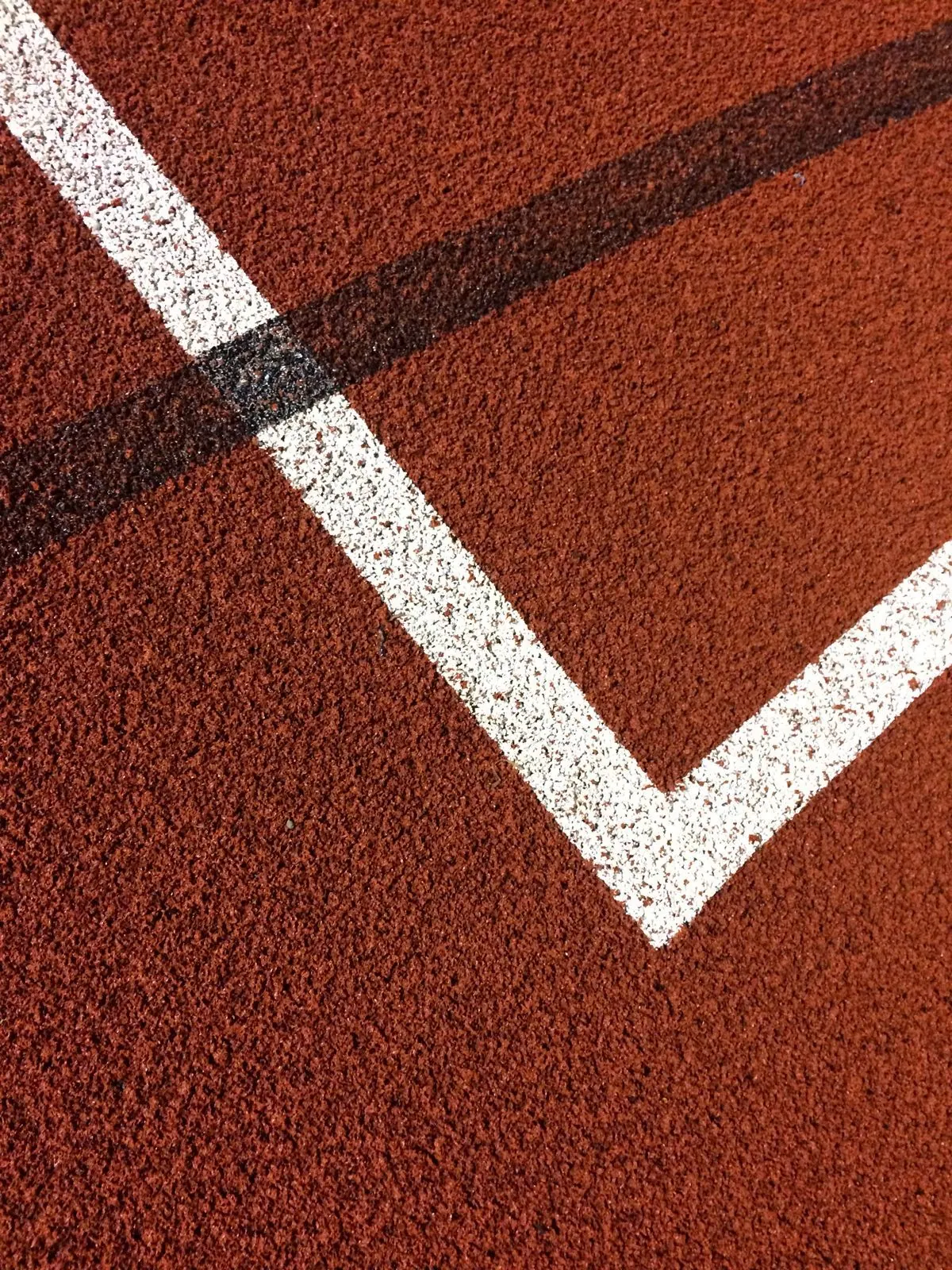
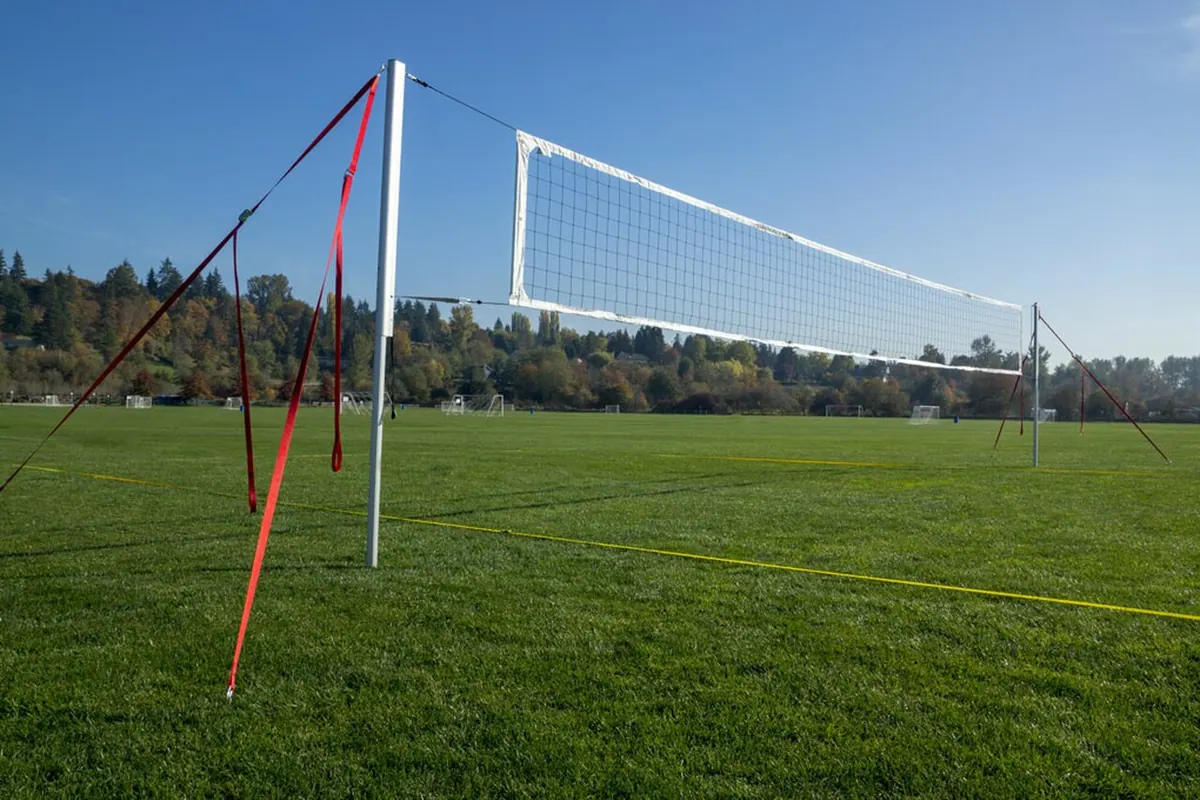
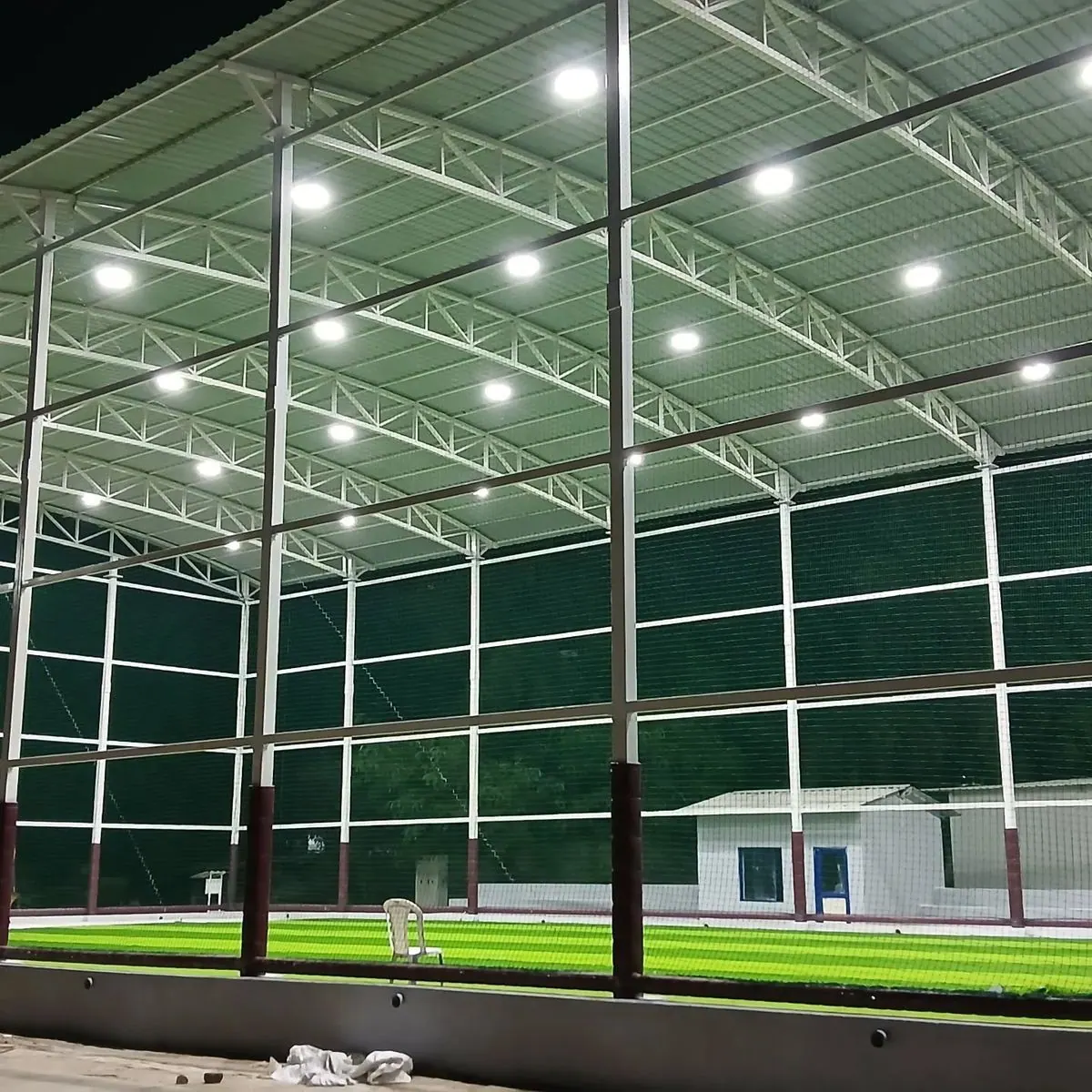
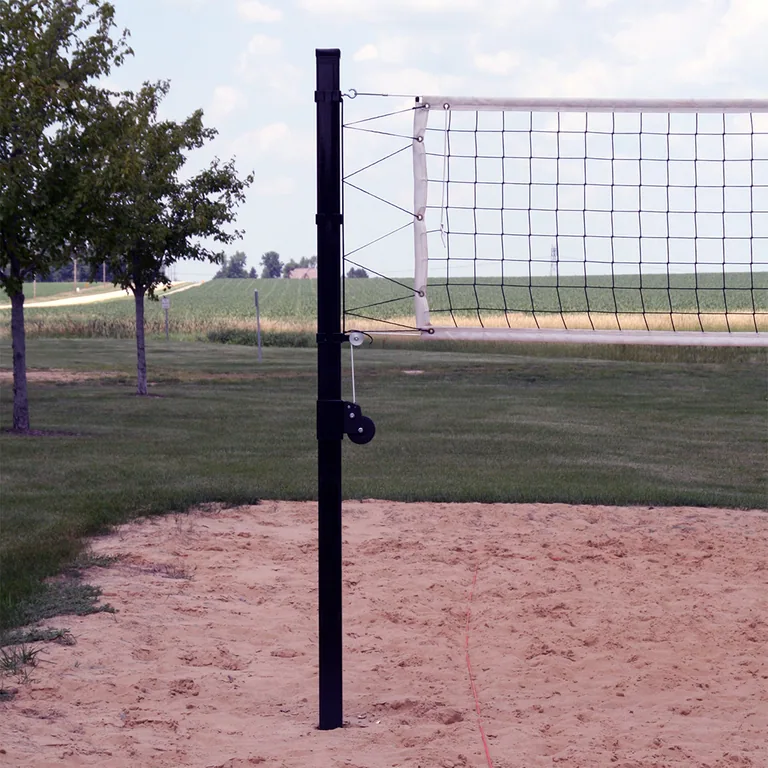
We build outdoor and indoor volleyball courts turnkey — from subbase and drainage to the net system. Current unit prices by surface type and the full dimensional standards are below.
Court, line markings and net system to TVF dimensions
If you already have a sound concrete slab, acrylic surfacing is the fastest and most economical route. The same system for tennis, basketball, volleyball and multi-purpose courts: slab conditions, preparation work and unit prices.
What a sand court really costs, item by item: excavation, sand, drainage gravel, geotextile, kerb and net set with quantities; hotel, municipal, residential and indoor scenarios plus the annual maintenance budget.
In 2026, the turnkey unit cost of an outdoor volleyball court ranges from 190 – 3.300 ₺/m² depending on the surface system chosen. A standard court with an 18 × 9 m playing area and a 3 m free zone on every side means a 24 × 15 m footprint — that is 360 m² of surfaced area.
The table below shows the unit price per surface system together with the total for a 360 m² reference court. The most common omission in this industry is quoting a price without stating the area it covers; here the area is fixed on every row, so the systems can be compared like for like.
Surface systems side by side: unit price and total cost
Surface systems — ₺/m², VAT excluded · 2026
Surface system
Unit price
Total for 360 m²
Service life
Standard acrylic
190 – 390 ₺/m²
68.400 – 140.400 ₺
8 – 10 years
Cushioned acrylic
210 – 620 ₺/m²
75.600 – 223.200 ₺
10 – 12 years
Synthetic turf (20–26 mm)
1.100 – 1.600 ₺/m²
396.000 – 576.000 ₺
8 – 10 years
EPDM / tartan
2.400 – 3.300 ₺/m²
864.000 – 1.188.000 ₺
12 – 15 years
PVC / polyurethane
900 – 2.500 ₺/m²
324.000 – 900.000 ₺
10 – 15 years
Indoor hardwood floor
1.500 – 7.500 ₺/m²
540.000 – 2.700.000 ₺
20 – 30 years
Resurfacing over an existing floor
450 – 900 ₺/m²
162.000 – 324.000 ₺
—
VAT excluded · based on a 24 × 15 m (360 m²) surfaced area · subbase is a separate item
Turnkey total cost scenarios
The surface covering is only one item in the total. The scenarios below show typical totals for a 360 m² outdoor court, including subbase, equipment and labour.
Economy
270.000 – 400.000 ₺
Standard acrylic over an asphalt base, basic LED lighting, no perimeter fencing.
Standard
450.000 – 750.000 ₺
Cushioned acrylic over a reinforced concrete slab, 4 m perimeter fence, LED floodlighting.
Unit cost for an indoor structure: 900 – 4.500 ₺/m²
Subbase and equipment items
The items below are for a 360 m² reference court. Those marked optional sit outside the core scope and can be removed to suit your budget.
Ground preparation and subbase
180.000 – 260.000 ₺
Excavation, fill, drainage, plant-mix base or crushed-stone blockage plus mechanically stabilised layer, asphalt or reinforced concrete slab.
Posts and net system
18.000 – 45.000 ₺
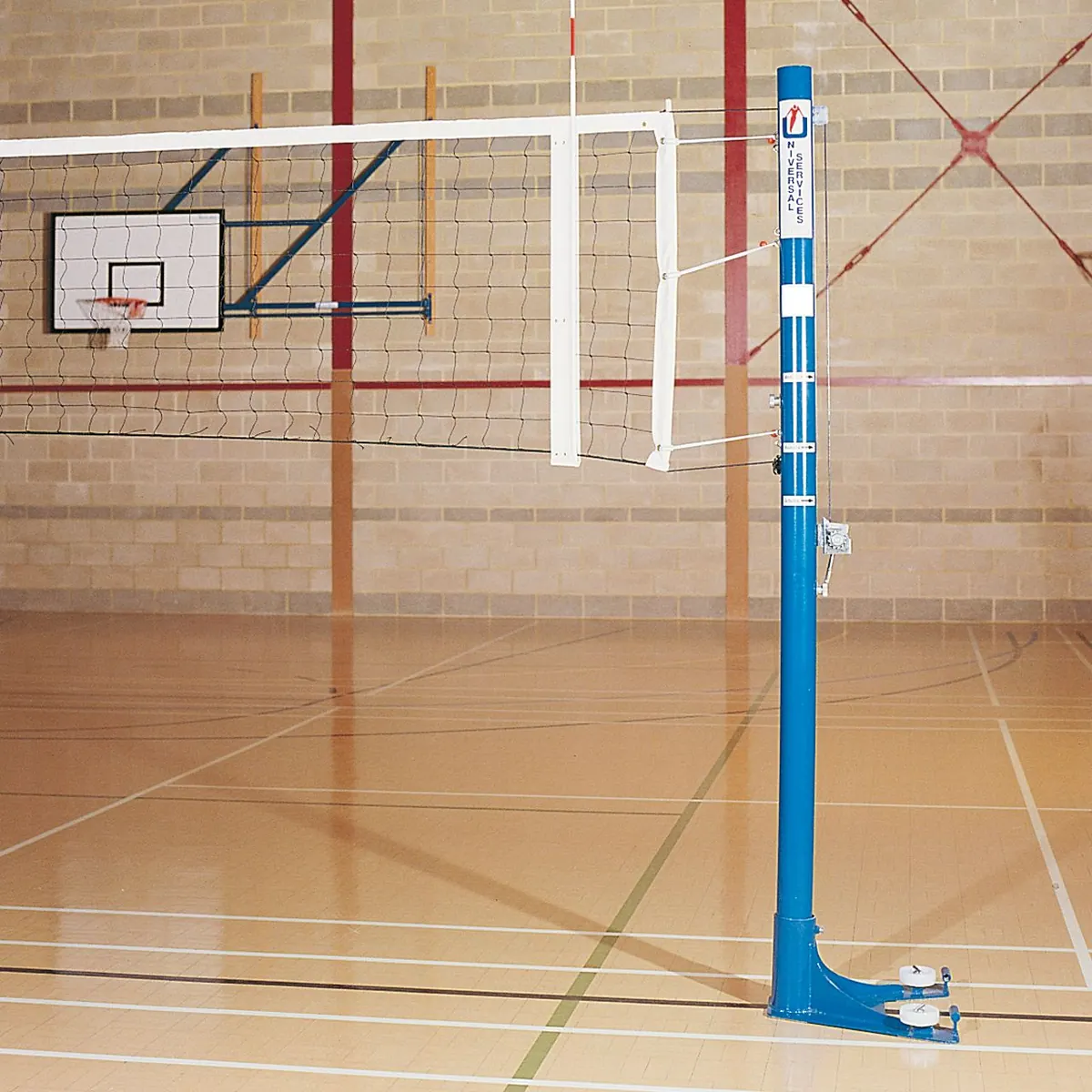
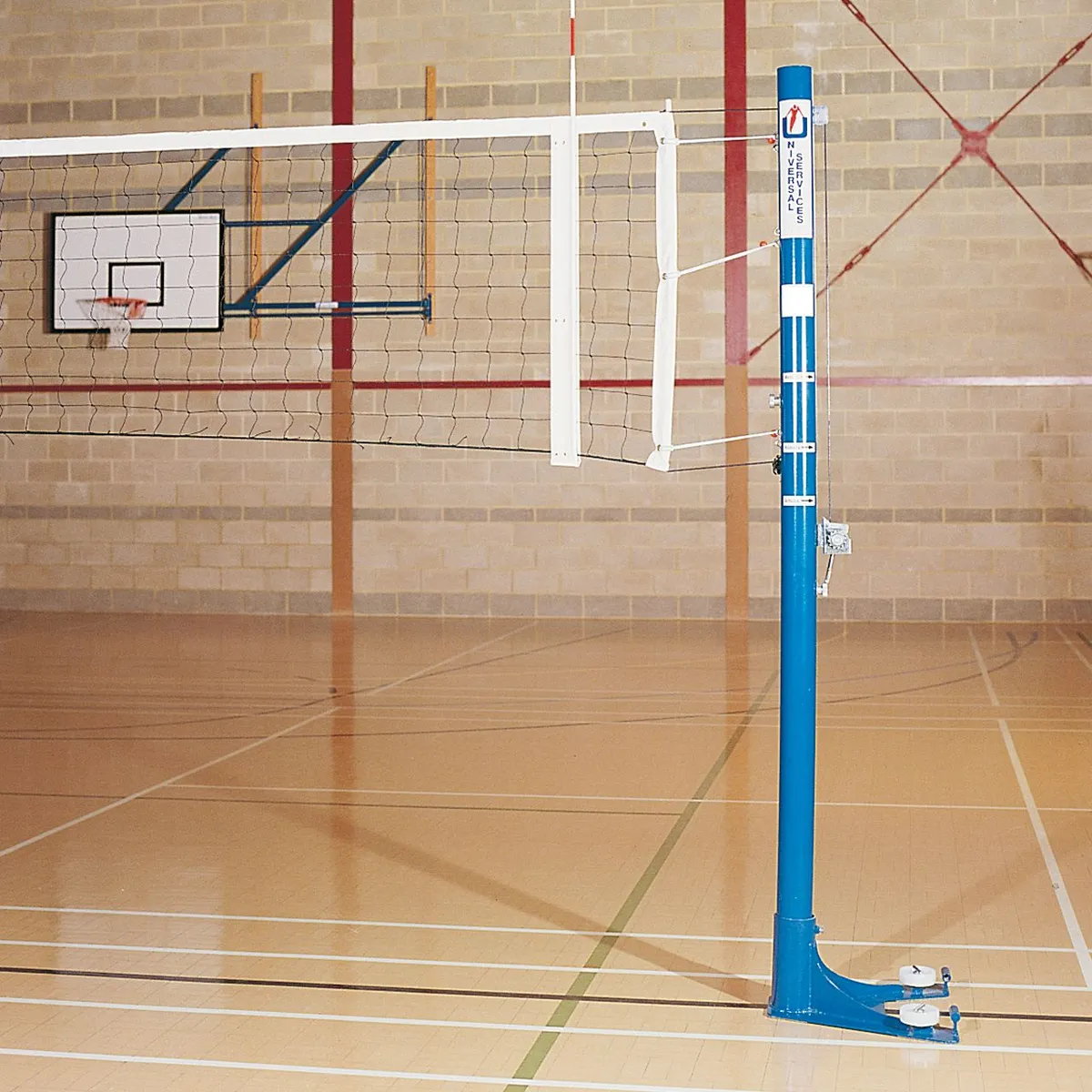
Galvanised steel posts on concrete anchors, adjustable mechanism, net and antennae to TVF/FIVB standard.
Line marking
6.000 – 15.000 ₺
5 cm wide lines in acrylic-based paint, attack line and service zone markings.
Lighting Optional
18.000 – 60.000 ₺
LED floodlights, poles, cabling and power supply. 300 lux is sufficient for training.
Perimeter fencing Optional
90.000 – 180.000 ₺
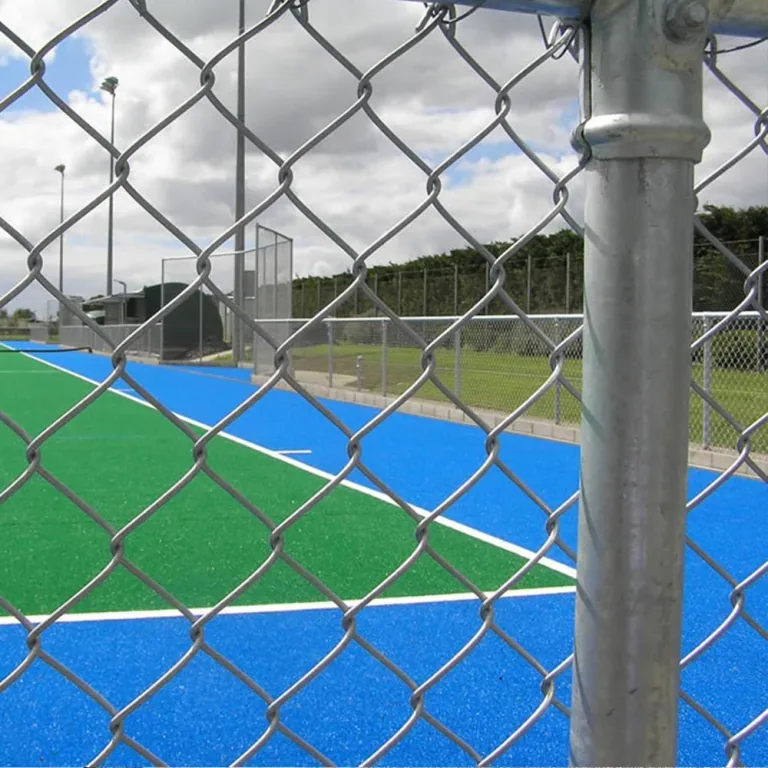
Minimum 4 m height, 60 × 2.00 mm main posts, 50 × 50 × 3.50 mm PVC-coated mesh.
These figures are a starting range
The ranges are starting bands prepared for 2026 market conditions. The final price is set item by item in a written quote after the site survey.
Tell us your dimensions and preferred surface; we will send an item-by-item written quote within 24 hours.
VAT excluded and not binding. Surface, subbase, posts-and-net and line marking are included; lighting and perimeter fencing are added according to your selection. The final price is set in a written quote after the site survey.
Where do these figures come from?
Where do these figures come from?
The unit prices behind this calculator are derived from 2026 quotations by contractors who actually build courts. Content farms and price-comparison pages were deliberately excluded as sources: those pages publish figures roughly six times the real cost for acrylic surfaces and never state the area being covered. In our table the area is fixed on every row, so the systems can be compared like for like.
What is included?
Surface covering, subbase and drainage, the post-net-antenna set and line marking are included in every scenario. Lighting and perimeter fencing are added optionally. Selecting an indoor court adds the building structure as a separate item. Not included: land cost, permit and design fees, changing rooms and seating structures, electricity connection.
How far can the estimate move?
On firm, level ground the real figure usually lands near the lower end of the range. Grade correction, rock encountered during excavation, demolition of existing concrete, or access too narrow for machinery push it toward the upper end. These three factors can only be seen during the site survey — which is why the calculator gives a range rather than a single number.
Why it varies
Six Factors That Set the Cost of a Volleyball Court
Two courts of the same size can differ by a factor of two. These are the six factors that create the gap.
01
Condition of the existing ground
This is the single biggest cost driver. If there is a sound concrete slab that can be surfaced directly, the subbase cost all but disappears. On bare soil, excavation, fill, drainage, crushed-stone blockage and a stabilised layer all come into play — that alone can reach a third of the total budget.
02
Surface system chosen
There is up to a tenfold difference per square metre between standard acrylic and EPDM/tartan. The surface covering makes up roughly 35 to 45 per cent of the total cost. Acrylic is enough for low-intensity school courts, while club and competition courts call for systems with high impact absorption.
03
Court size and free zone
The 18 × 9 m playing court is fixed; what changes is the free zone. With the standard 3 m free zone the total is 360 m²; at international competition dimensions (5 m at the sidelines, 6.5 m at the end lines) it rises to 532 m². That is roughly a 48 per cent increase in surfaced area.
04
Outdoor or indoor
An indoor court brings steel structure and roofing into scope. In volleyball this gap is wider than in football: because at least 7 m of clear height above the playing court is mandatory, the structure has to be taller and heavier.
05
Perimeter equipment and lighting
A perimeter fence at least 4 m high is effectively mandatory outdoors, since it keeps the ball on the court; seating, referee stand, scoreboard and windbreak netting are optional. The correct unit for lighting is lux, not watts: at least 300 lux at the surface is enough for training, while official competition conditions call for 2,000 lux. That gap directly drives the number of luminaires, the pole height and the electrical supply.
06
Location and transport
Site access, material haulage and crew accommodation vary by region. In Ankara and neighbouring provinces the transport item is low; in distant provinces and at high altitude both logistics and the working calendar feed into the cost.
Volleyball Court Dimensions and TVF/FIVB Standards
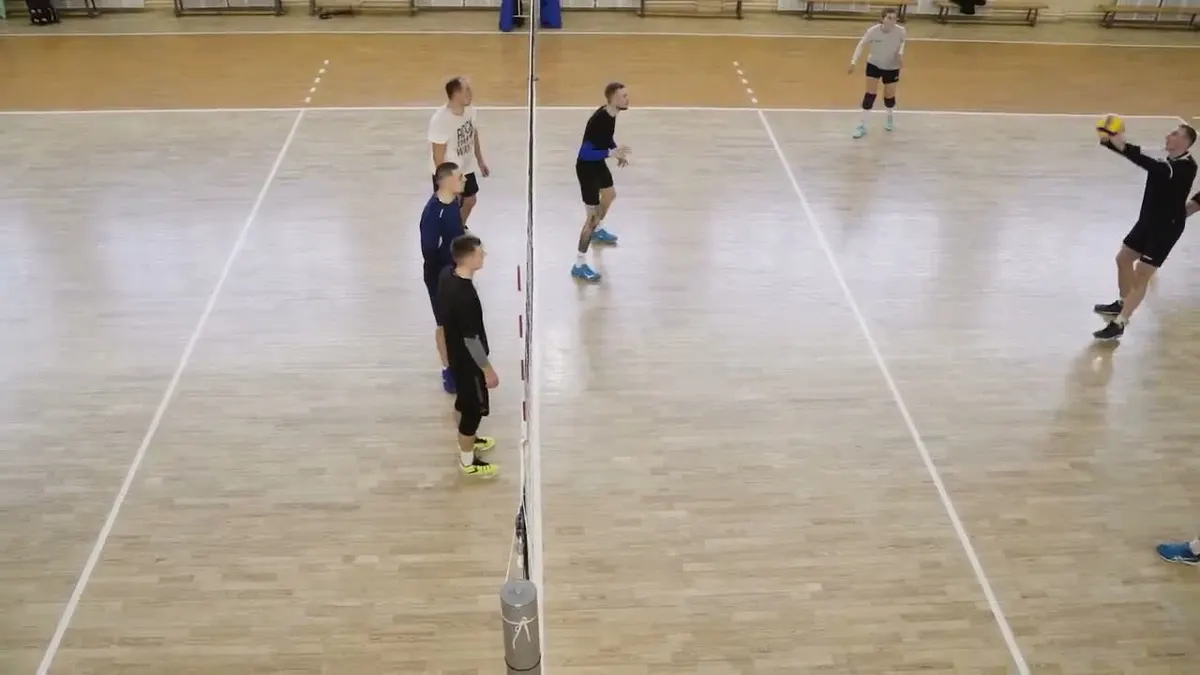
A volleyball playing court is a rectangle measuring 18 × 9 m, surrounded by a free zone at least 3 m wide on every side. The free playing space above it must be at least 7 m high, measured from the playing surface.
15 × 24 m
Surfaced area360 m²
Playing court18 × 9 m
Free zone3 m on every side
The standard size, sufficient for training and local competition. Most school, housing-estate and municipal courts are built to this size.
The values below are taken from the FIVB Official Volleyball Rules 2025-2028 as published by the Turkish Volleyball Federation. Court design is based on these dimensions. The one thing that cannot be corrected afterwards is a shortage of space: the surface can be renewed, the net replaced, the lighting upgraded — but if there is no room for the free zone, the court is permanently outside competition use.
Court diagram: lines, zones and free area
Volleyball court plan diagram — playing court, attack lines, service zone and free zone.
Court dimensions — standard against FIVB official
Dimension
Standard
FIVB World and Official Competitions
Playing court
18 × 9 m
18 × 9 m
Free zone
At least 3 m on every side
5 m at the sidelines · 6.5 m at the end lines
Total court area
24 × 15 m (360 m²)
31 × 19 m (589 m²)
Free playing space
At least 7 m above the surface
At least 12.5 m
Warm-up area
—
Approximately 3 × 3 m, outside the free zone
Line width
5 cm
5 cm, white
Attack line
3 m behind the centre line
Plus a 1.75 m broken extension on each side
Net system and post standards
Net height — men
2.43 m
Net height — women
2.24 m
Edge height tolerance
No more than 2 cm
Net width
1 m (± 3 cm)
Net length
9.5 – 10 m
Mesh
10 cm square, black cord
Top band
7 cm, double-layer white canvas
Bottom band
5 cm, with cord threaded through
Side bands
5 cm × 1 m, over the sideline
Antenna
1.80 m × 10 mm, fibreglass
Antenna above the net
80 cm
Antenna marking
10 cm stripes, red and white
Post height
2.55 m
Post to sideline distance
0.50 – 1 m (FIVB: 1 m)
Playing environment: light, temperature and height
The correct unit for lighting is lux, not watts. Watts tell you only how much energy a fixture consumes; they say nothing about how much light reaches the surface. Two fixtures of the same wattage produce very different lux on court if the beam spread and the pole height differ. Because tracking the ball in the air is critical in volleyball, even light distribution and the prevention of glare matter more than the total wattage. Under the rules no match is played when the ambient temperature falls below 10 °C; that is why heating is not an optional line item when an indoor court is designed.
300 lux
Minimum illuminance for a training court
2,000 lux
Illuminance for FIVB official competition
10 °C
Lowest ambient temperature for play
7 m
Unobstructed height above the playing court
Total area by court type
The playing court is fixed in every type; what changes the total area is the free zone. Design follows whichever type your plot can take — cutting into the free zone is the one irreversible decision that puts a court outside competition use.
Court type
Playing court
Total area
Note
Standard court
18 × 9 m
24 × 15 m (360 m²)
Training and local competition
Widened
18 × 9 m
28 × 19 m (532 m²)
5 m free zone on all four sides
FIVB official competition
18 × 9 m
31 × 19 m (589 m²)
5 m at the sides, 6.5 m at the ends
School yard (Ministry of Education)
18 × 9 m
22 × 13 m (286 m²)
Lessons and training; not competition compliant
Beach volleyball
16 × 8 m
22 × 14 m (308 m²)
Free zone 3 – 6 m
Source
Every dimension and standard in this section is taken from the FIVB Official Volleyball Rules 2025-2028 as published by the Turkish Volleyball Federation. Beach volleyball and school-yard dimensions fall outside the rule book; they are compiled from the beach volleyball rules and the Ministry of Education school-yard planning principles respectively.
Surface systems
Volleyball Court Surface Types and Where Each One Belongs
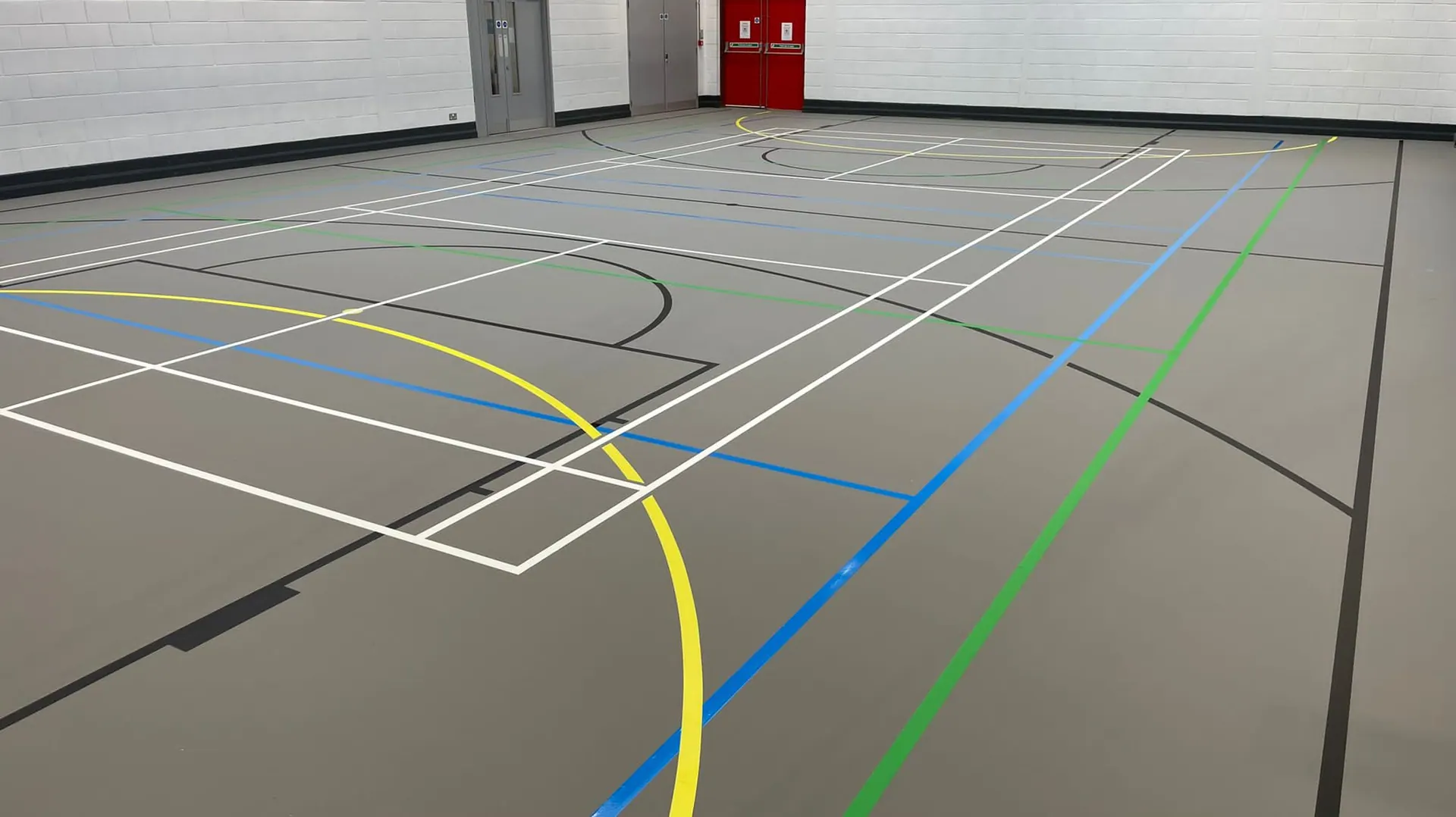
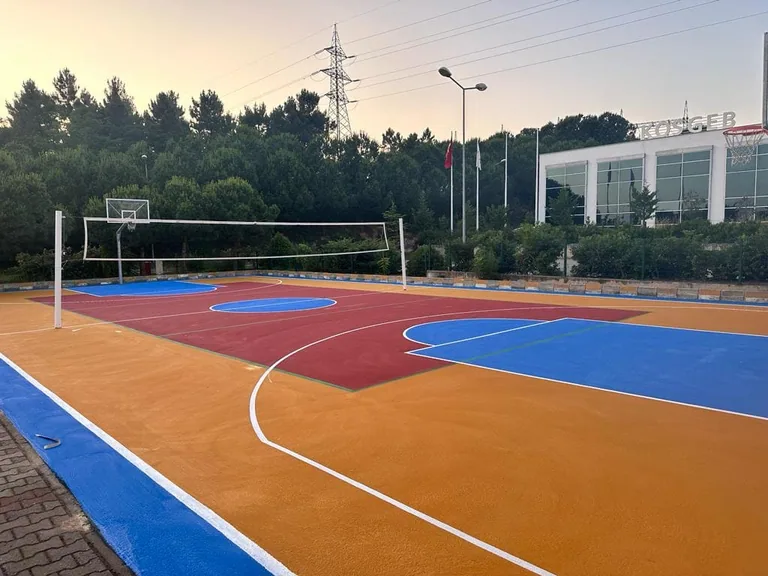
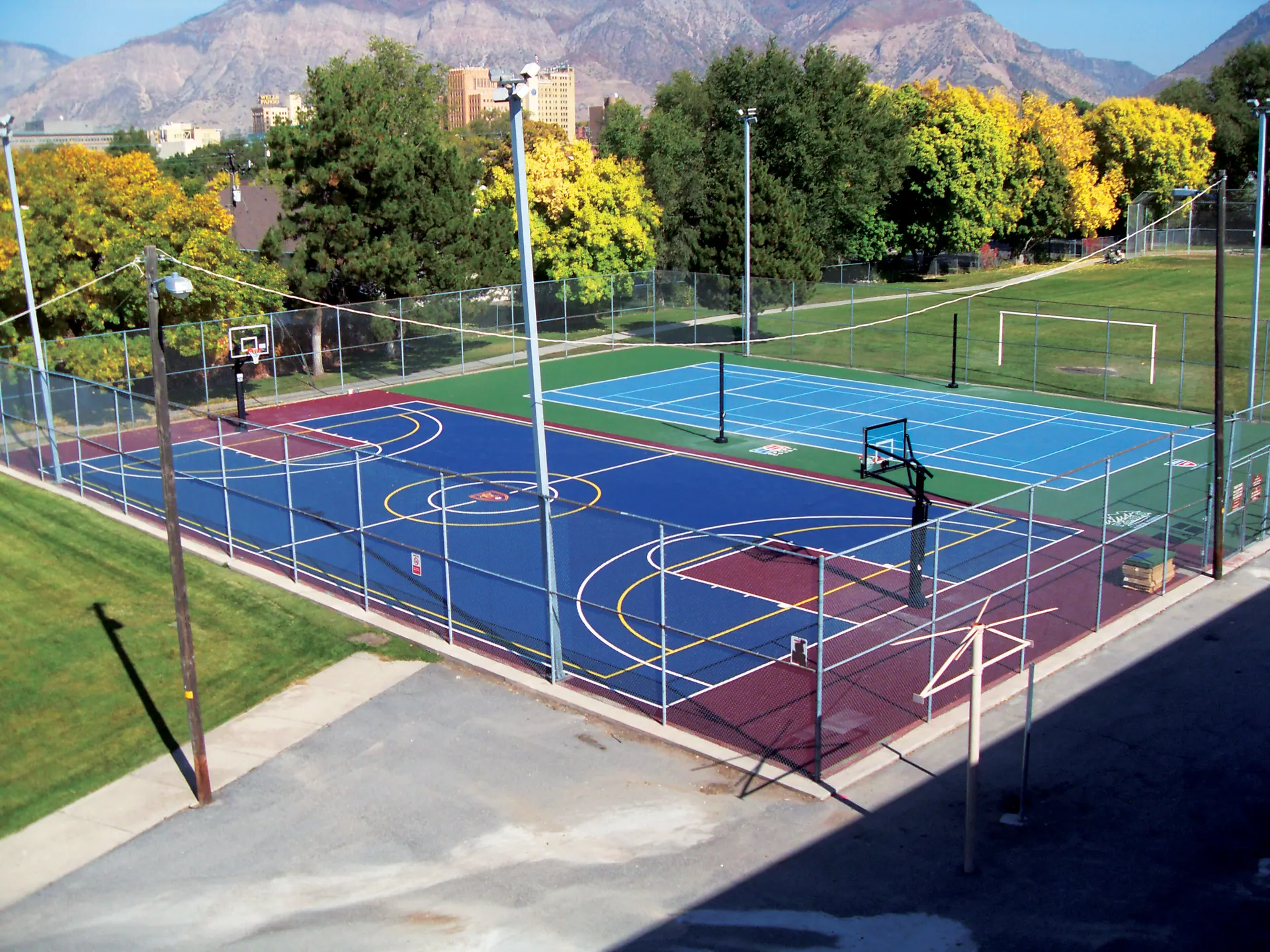
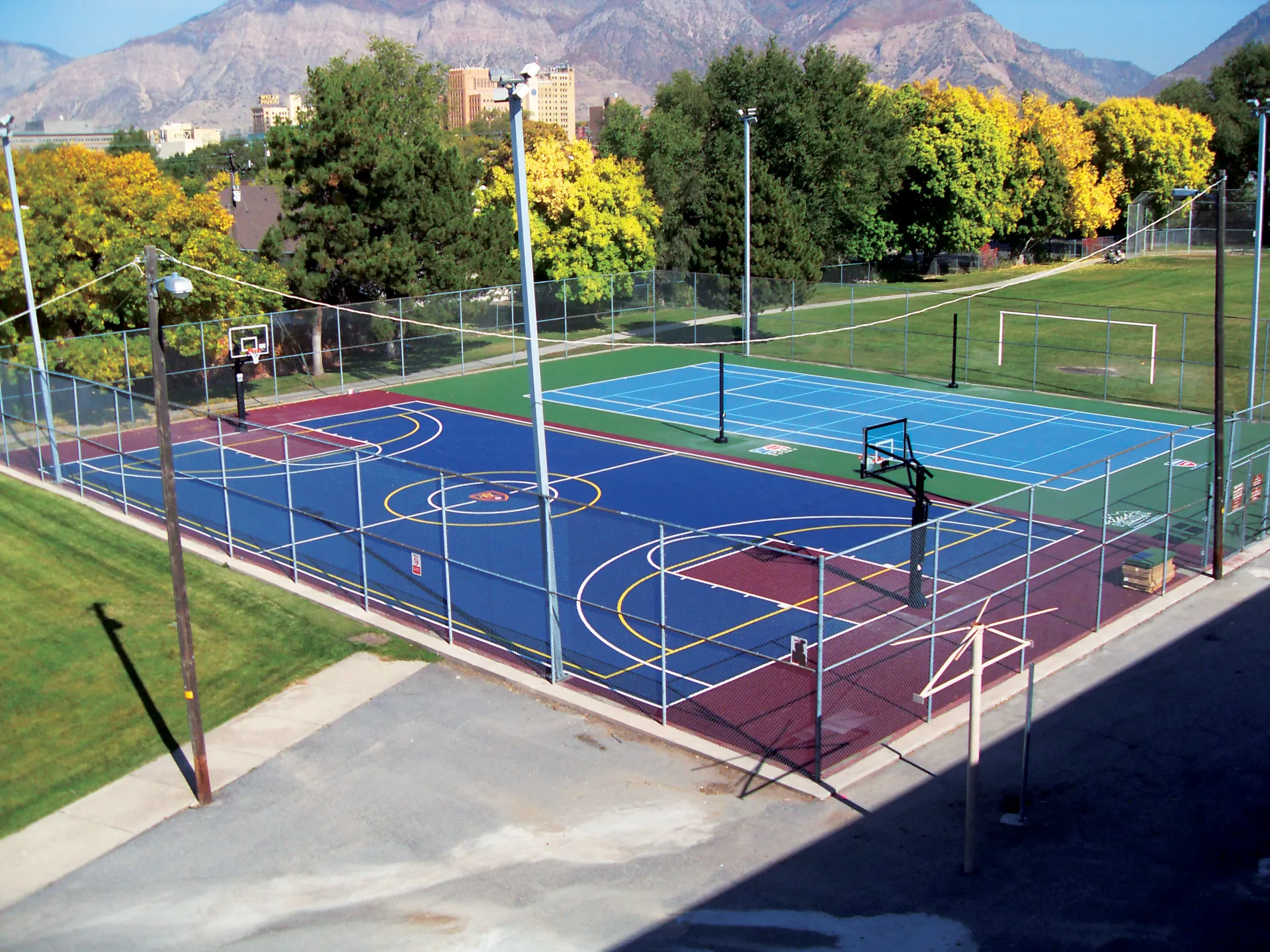
The most common system on outdoor volleyball courts is acrylic coating; it is applied over an asphalt or concrete base, is economical, and gives crisp line definition. On courts used for heavy training, cushioned acrylic or EPDM/tartan is chosen for impact absorption, while indoor halls favour hardwood.
Choosing a surface is not a preference on its own; it follows from how intensively the court will be used. A school court used three hours a week and a court hosting club training do not carry the same system. Each system is explained separately below, and all of them are compared in a single table at the end. The prices cover the covering system only; the substructure is not included.
Compared: location, service life, maintenance load and unit price
VAT excluded · based on a 24 × 15 m (360 m²) surfaced area · subbase is a separate item
The strengths and weaknesses of each surface system
Total thickness1.5 – 2 mm
Number of coats4 coats
Base requiredAsphalt or concrete
Curing10–15 days on asphalt
Standard acrylic
190 – 390 ₺/m²VAT excl. · 8–10 years
A system of primer, filler and two coloured acrylic coats applied over an asphalt or reinforced concrete slab. What makes it the most used outdoor solution is not cost but its balance of durability: it resists UV, dries quickly after rain, and takes line marking cleanly. Most school yards, housing-estate courts and municipal courts are built this way.
What to watch for
There is no impact absorption. On club courts used several hours a day the load on players’ knees and ankles rises; for that pattern of use, stepping up to a cushioned system is the sounder long-term choice.
It carries the same upper build-up as standard acrylic; the difference is an elastic rubber interlayer laid beneath the colour coats. That layer takes part of the landing and jumping load. Because a volleyball player jumps and lands continuously, impact absorption matters far more here than on a five-a-side pitch — which is why cushioned systems come to the fore in volleyball.
What to watch for
The thickness of the interlayer is often left out of quotations. The words “cushioned acrylic” on their own mean nothing; how many millimetres of elastic layer will be laid must appear in the contract as a figure.
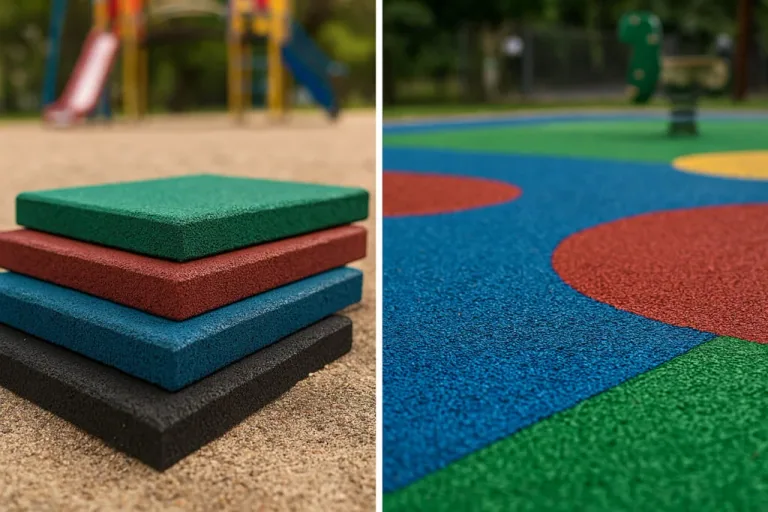
A cast-in-place EPDM granule system with a polyurethane binder. The surface familiar from athletics tracks is used in volleyball as well. It offers the highest impact absorption of any outdoor solution, and because the colour pigment is in the granule itself, it fades far more slowly than painted systems. Against that, its cost per square metre is several times that of acrylic.
What to watch for
On cast-in-place systems, air temperature and humidity directly affect how the mix sets. The programme must be able to shift with the weather; a tight handover date is a quality risk on this system.
Either a multi-layer PVC sports floor supplied in rolls, or a cast-in-place polyurethane system. Indoors it is the alternative to hardwood; ball bounce and slip resistance are defined by measurable values. It can be used outdoors too, but a UV-resistant type must be specified.
What to watch for
Indoors, roll flooring must not be laid before the moisture content of the concrete below has been measured. Moisture rising from the slab breaks down the adhesive and the floor lifts within a season.
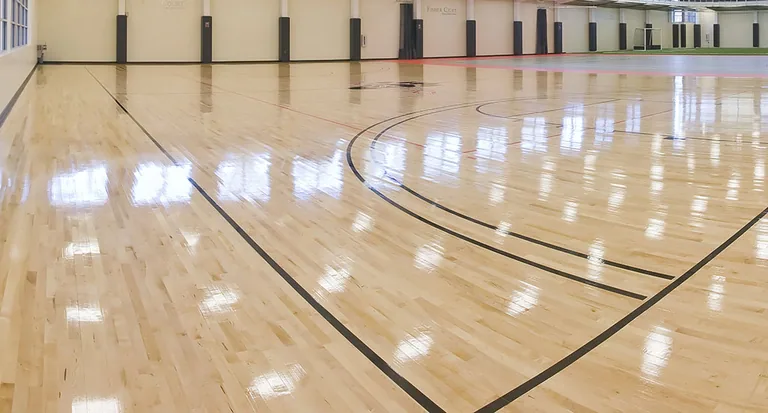
Solid timber boards laid over a system of battens and elastic pads that provide the spring. It is the standard for official competition halls. Its service life is a multiple of the other systems, and it can be sanded and re-varnished many times over — which is how its high initial cost is repaid over the long run.
What to watch for
Hardwood works only if the hall’s relative humidity can be held in the 35–65 per cent band: it dries and shrinks in winter, swells in summer. The ventilation design is part of the floor design.
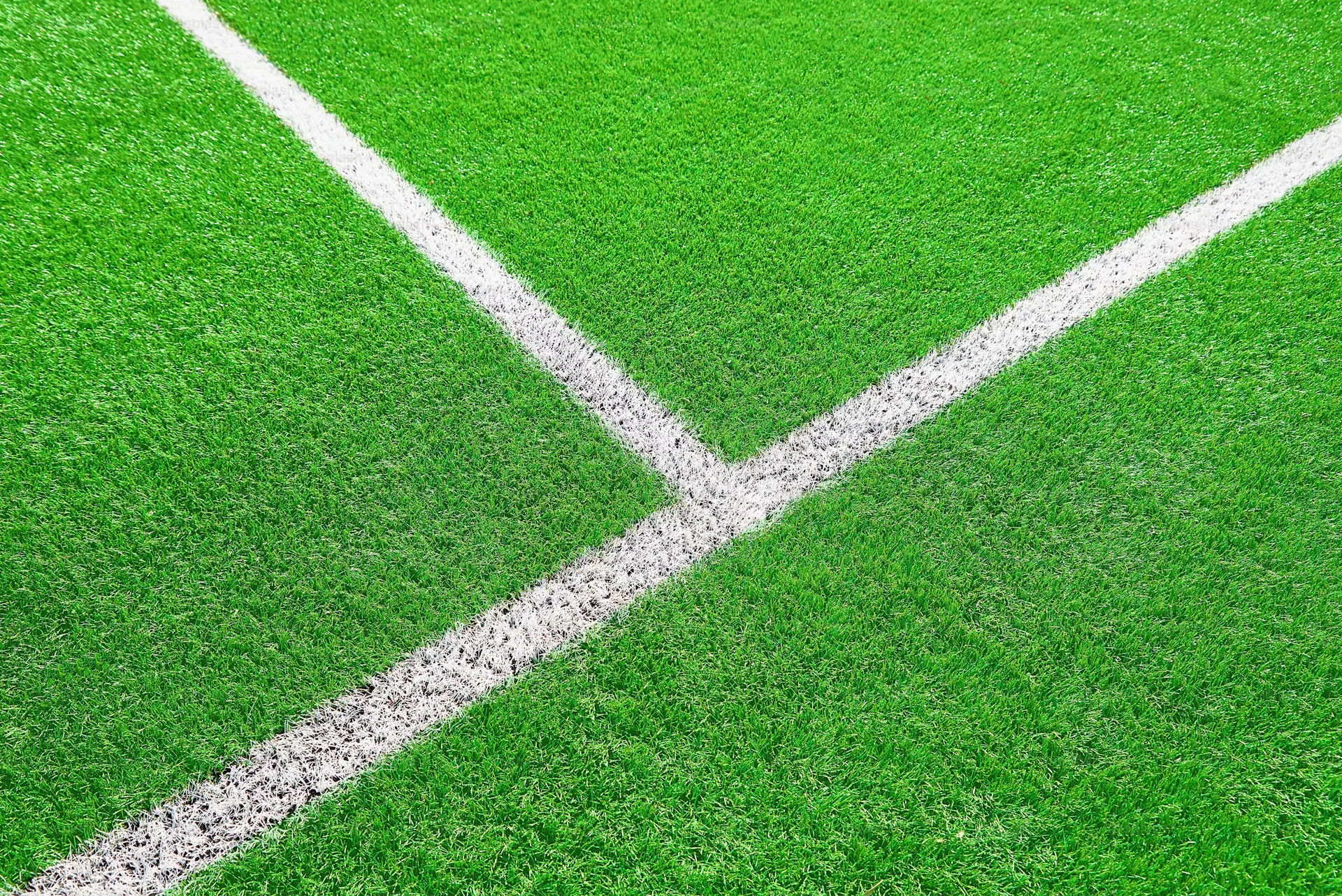
Not an ideal surface for volleyball, but it is chosen when five-a-side football, basketball and volleyball will share the same area. If it is to be used for volleyball, the pile height should be kept low and the infill reduced — tall pile makes the ball bounce unpredictably.
What to watch for
For a single-sport volleyball court, synthetic turf is not recommended. In multi-purpose use the volleyball lines should be woven in as differently coloured turf strips rather than painted; paint does not last a season on turf.
Prefabricated rubber tile or roll is the quick solution over an existing sound concrete slab. It finishes faster than a cast system and a damaged area can be replaced piece by piece. In volleyball it is used mainly for training and multi-purpose areas.
What to watch for
Tile joints can open over time. Because volleyball players slide and fall to the floor, an open joint is an injury risk; an annual joint inspection belongs in the maintenance plan.
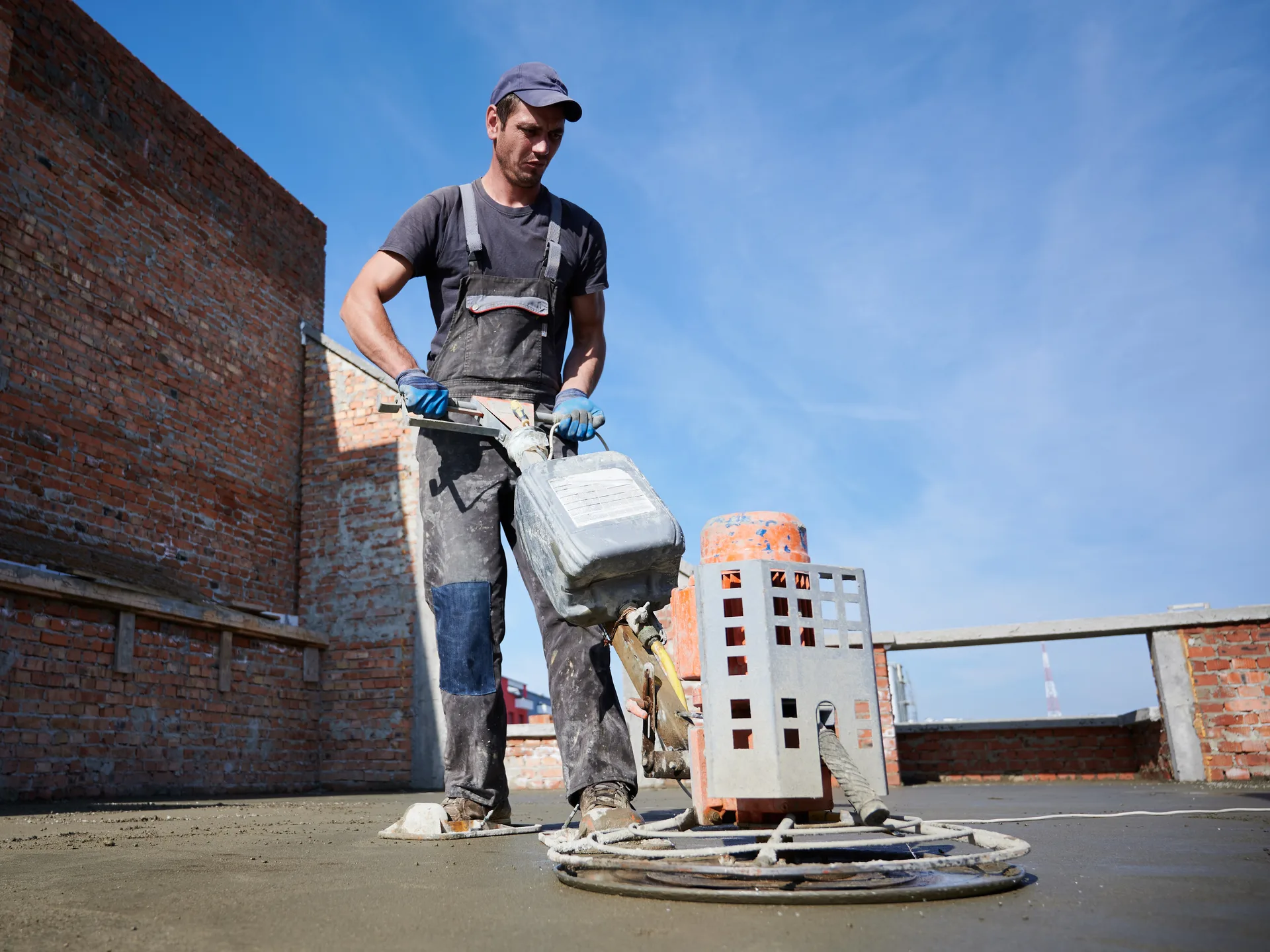
Power-trowelled concrete is the base a covering is laid on; it is not a finished playing surface. On a court played directly on concrete there is no impact absorption at all, the surface friction injures players, and painted lines do not last a season. The job of the concrete is to give a level, load-bearing base.
What to watch for
If the budget will not stretch, the right answer is not to leave the concrete bare but to move the covering to a more economical system. For a covering to be added later, the trowel finish and the fall of the slab have to be right from the start.
Acrylic Surface Cross-Section of a Volleyball Court
An acrylic volleyball court is not a single coat of paint. The cross-section below shows the layers applied from the base up to the surface.
Acrylic system cross-section from base to surface — thicknesses are to scale.
Base
Excavation, mechanically stabilised fill and drainage. A base that holds water finishes any system quickly.
Slab
Asphalt or reinforced concrete slab. Asphalt needs 10–15 days of curing.
Primer + filler
Levelling filler and acrylic primer; this layer provides the adhesion.
Top coat + lines
Two coats of coloured acrylic and 5 cm white line marking.
Why the order of layers cannot be changed
Each layer carries the one above it. Skip the mechanically stabilised base and lay asphalt straight onto soil, and the base settles in the first winter and the asphalt breaks up. Skip the primer and apply acrylic directly onto asphalt, and there is no adhesion; the covering flakes off within a season. Skip the filler layer and the surface texture of the asphalt reads through the colour coat, leaving the court patchy. That is why the first thing to look at when comparing quotations is not the price but how many layers are written down — a missing layer is the easiest saving to hide.
Differences Between Outdoor and Indoor Volleyball Courts
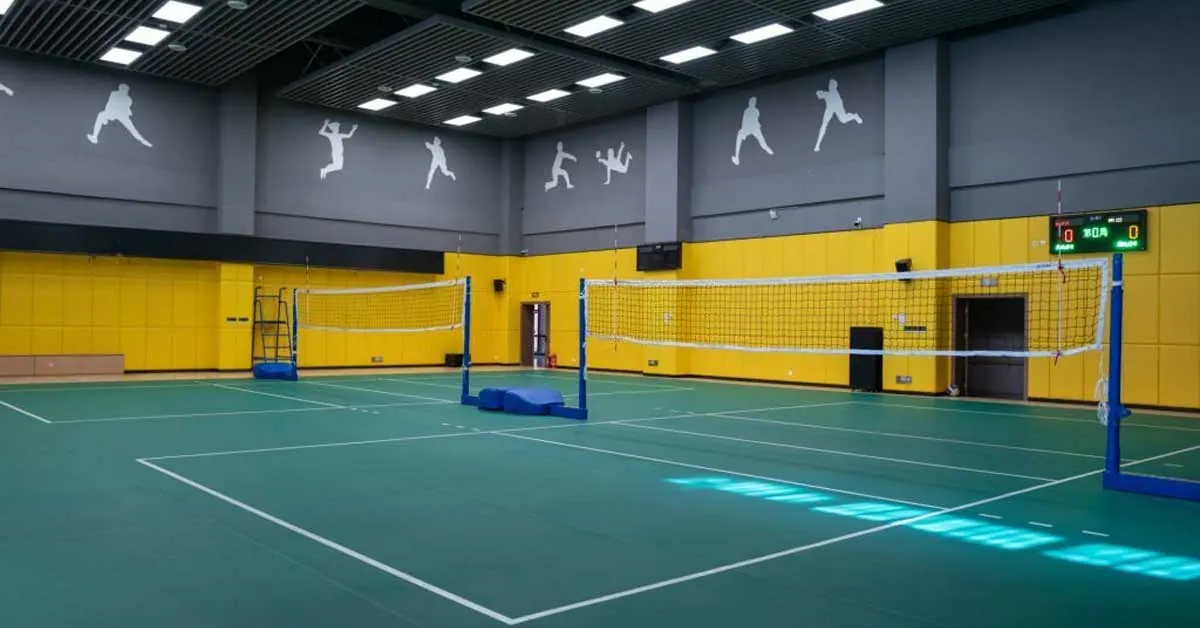
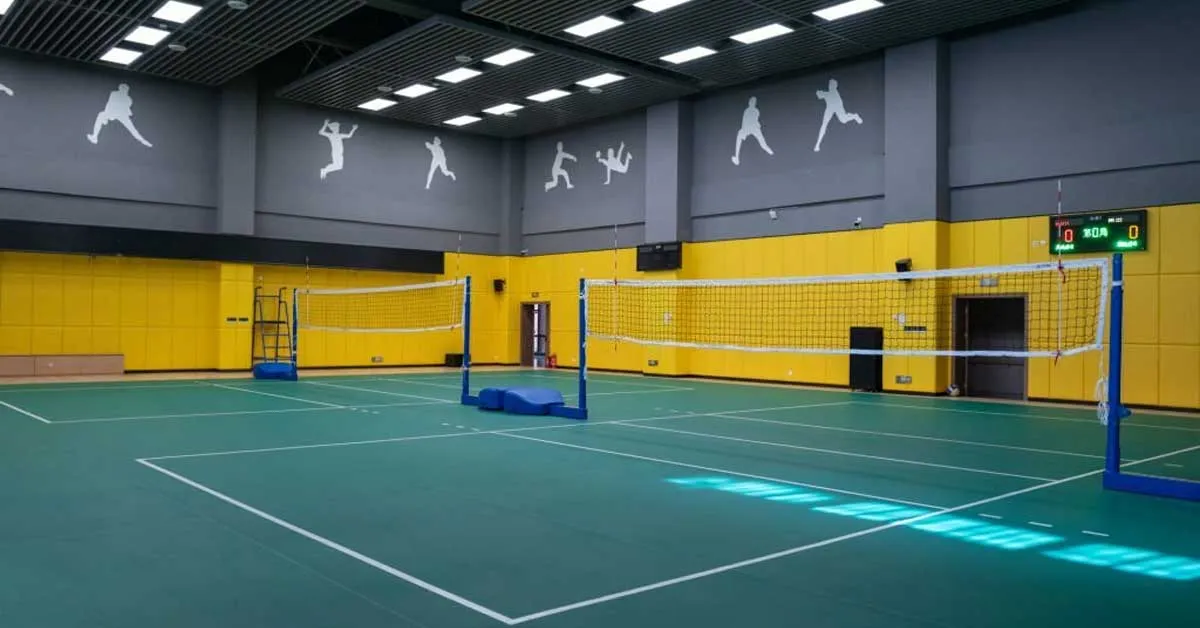
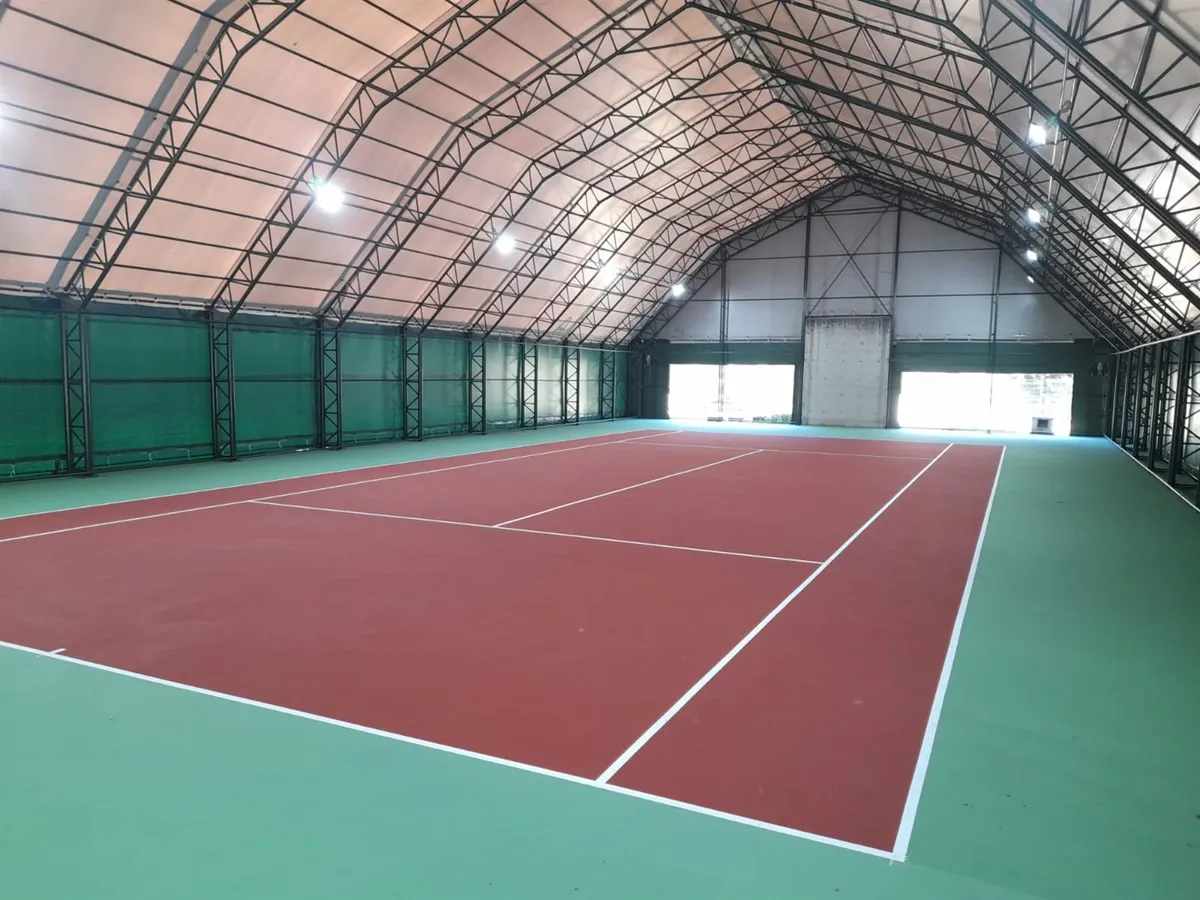
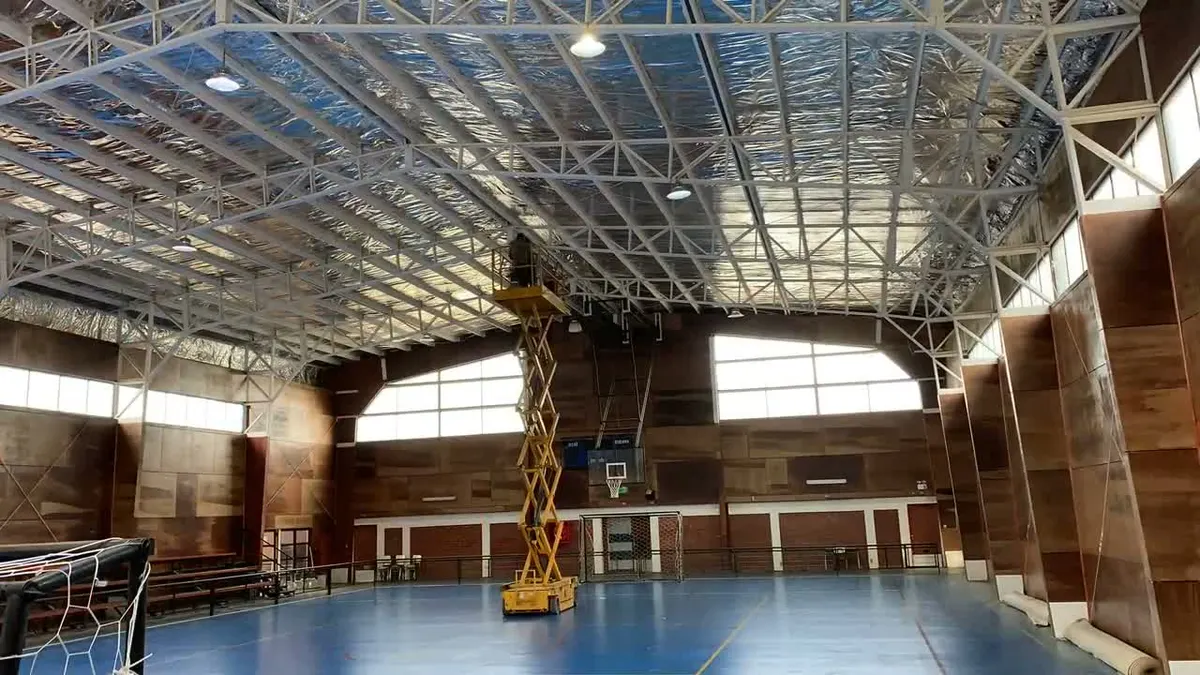
An outdoor volleyball court is completed in 25–30 days and suits seasonal use; an indoor court takes 45–60 days because it needs a steel structure and a roof, and is used twelve months a year. In volleyball the most critical condition for an indoor court is at least 7 m of unobstructed height above the playing area.
Outdoor volleyball court
StructureNone
SurfaceAcrylic, cushioned acrylic, EPDM/tartan
Build time25 – 30 days
UseSeasonal (weather dependent)
Perimeter fenceEffectively mandatory, min. 4 m
LightingPole-mounted floodlight system
Indoor volleyball court
StructureSteel structure + roof
Ceiling heightAt least 7 m unobstructed
SurfaceHardwood, PVC, polyurethane, EPDM
Build time45 – 60 days
Use12 months
Extra requirementVentilation, humidity control
Why is ceiling height critical indoors?
Volleyball is a sport that needs vertical space above the playing area. The rules require at least 7 m of height above the playing surface with no obstruction at all — and that includes lighting fixtures, roof trusses, ventilation ducts and cable trays. A covered structure designed for five-a-side football or basketball may be unsuitable for volleyball because of the level under the trusses, even when the ceiling height looks sufficient. That is why the figure that counts when designing an indoor volleyball court is not the roof level but the unobstructed playing space.
Steel structure and roof options
There are three common solutions for indoor courts. Lattice truss systems are the most economical and span the opening without columns. Arched structures are preferred for wide spans because they distribute load more evenly. Membrane roofs stand out for their light weight and natural light transmission; they markedly reduce the need for interior lighting during daylight hours. All three can be clad with sandwich panel, trapezoidal sheet or PVC membrane.
Where does the cost difference come from?
On an indoor court most of the cost is the superstructure, not the surface. Steel structure, roof cladding, side elevations and erection labour can make up more than half the total. And because the surface system is usually hardwood or PVC, the unit price is higher than outdoors as well.
An indoor court and a sports hall are not the same thing
This distinction is the one most often confused in the industry, and it misleads anyone researching prices. An indoor volleyball court is a playing area with a cover over it. A sports hall additionally contains changing rooms, showers, seating, heating, a spectator entrance and administrative space. The high cost figures found online usually belong to the second. Clarifying which one you want makes quotations comparable.
From Survey to Handover: How a Volleyball Court Is Built
An outdoor volleyball court is completed in ten stages, in 25–30 days on average. Indoor courts take 45–60 days because the steel structure and roof are added.
The durations below assume a single court built under standard conditions. Weather, ground condition and permit processes can extend the calendar. On courts where acrylic is laid over asphalt, the curing period is part of the calendar and cannot be shortened.
011 – 3 days
Site survey and needs analysis
The site is inspected on the ground; level differences, the bearing capacity of the existing ground, the direction of water run-off and the surrounding conditions are measured. The intended use (school, club, housing estate, municipality) and the expected intensity of use become clear at this stage. Whether the area is sufficient is decided here — and that is the one thing that cannot be corrected later.
022 – 5 days
Design and written specification
Court layout, dimensions, surface system, drainage solution, lighting calculation and equipment list are turned into a written specification, item by item. The quotation is issued against that specification, so which items are included and which are not is clear from the start.
033 – 7 days
Excavation, fill and drainage
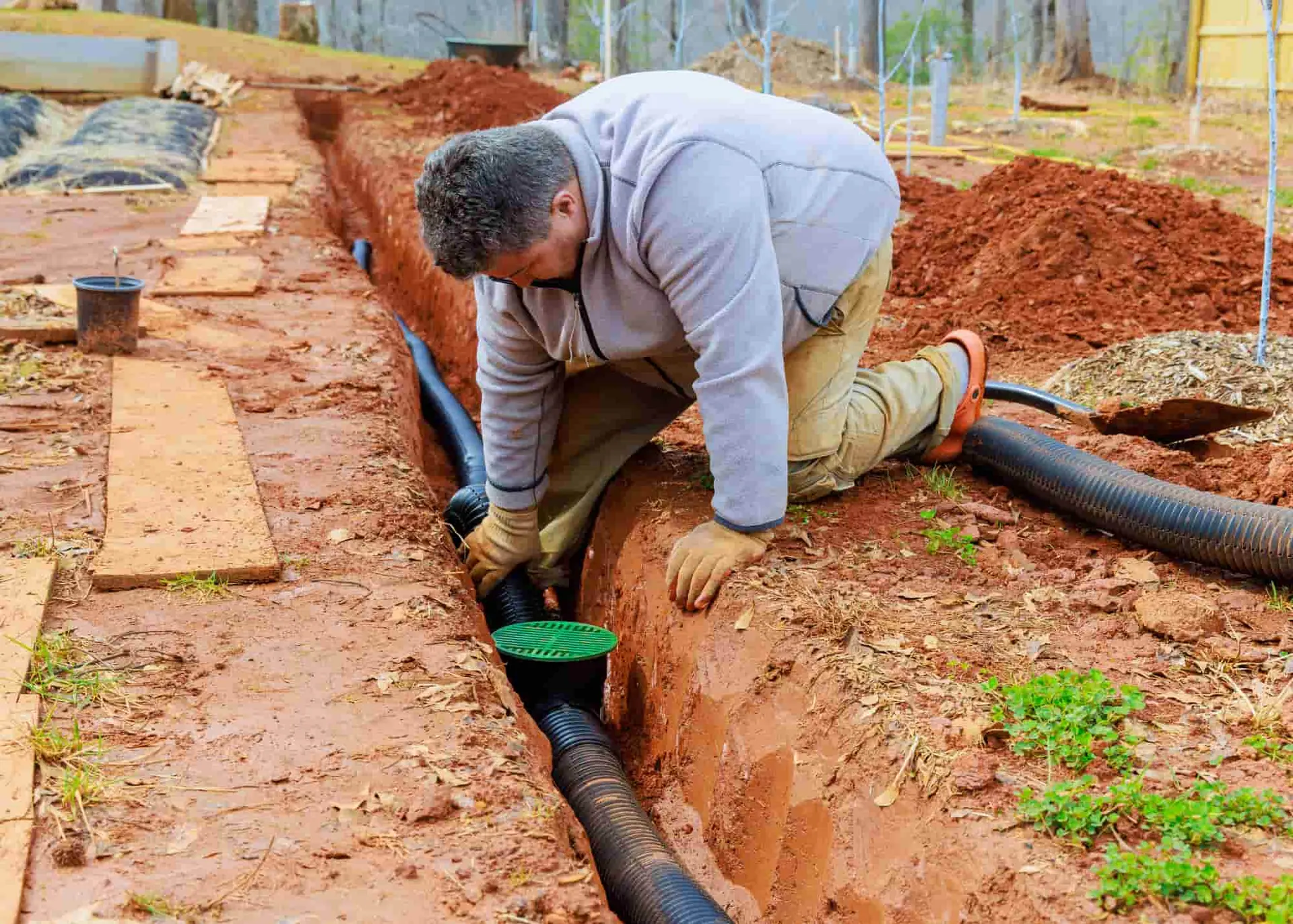
The court area is levelled and compacted. A fall of roughly 0.7 per cent is given so surface water drains away. Depending on ground conditions, 10 cm of gravel blinding and 15 cm of mechanically stabilised base are laid, or a plant-mix base is applied. The drainage pipe is run towards the point where water will be taken off the site.
044 – 8 days
Ring beam and court base
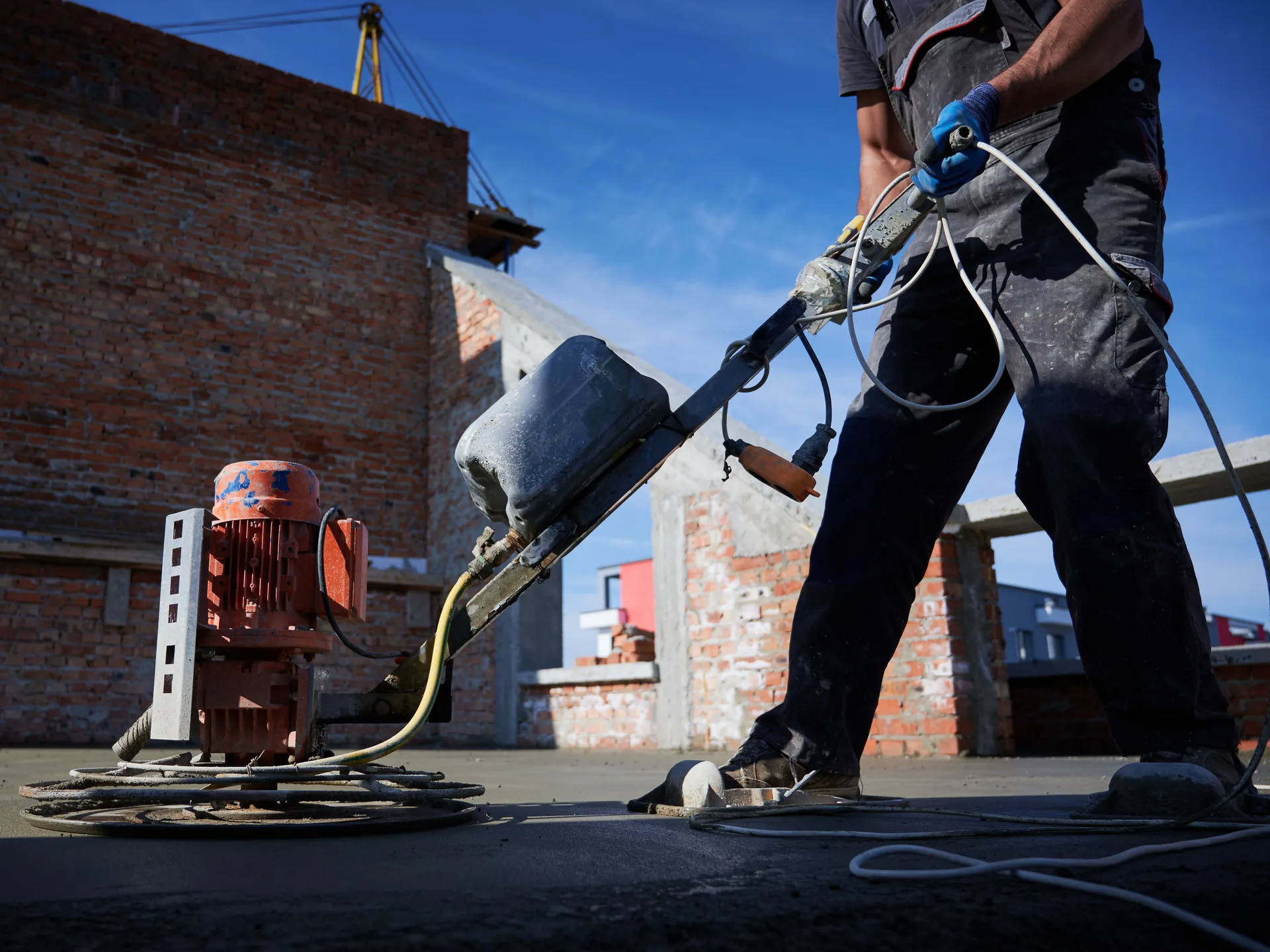
A reinforced ring beam 20 × 40 cm is cast around the court. The beam is the load-bearing frame that stops the covering lifting at its edges. After the mesh-reinforced concrete is poured, the surface is finished with a power trowel.
052 – 4 days + curing
Asphalt or reinforced concrete slab
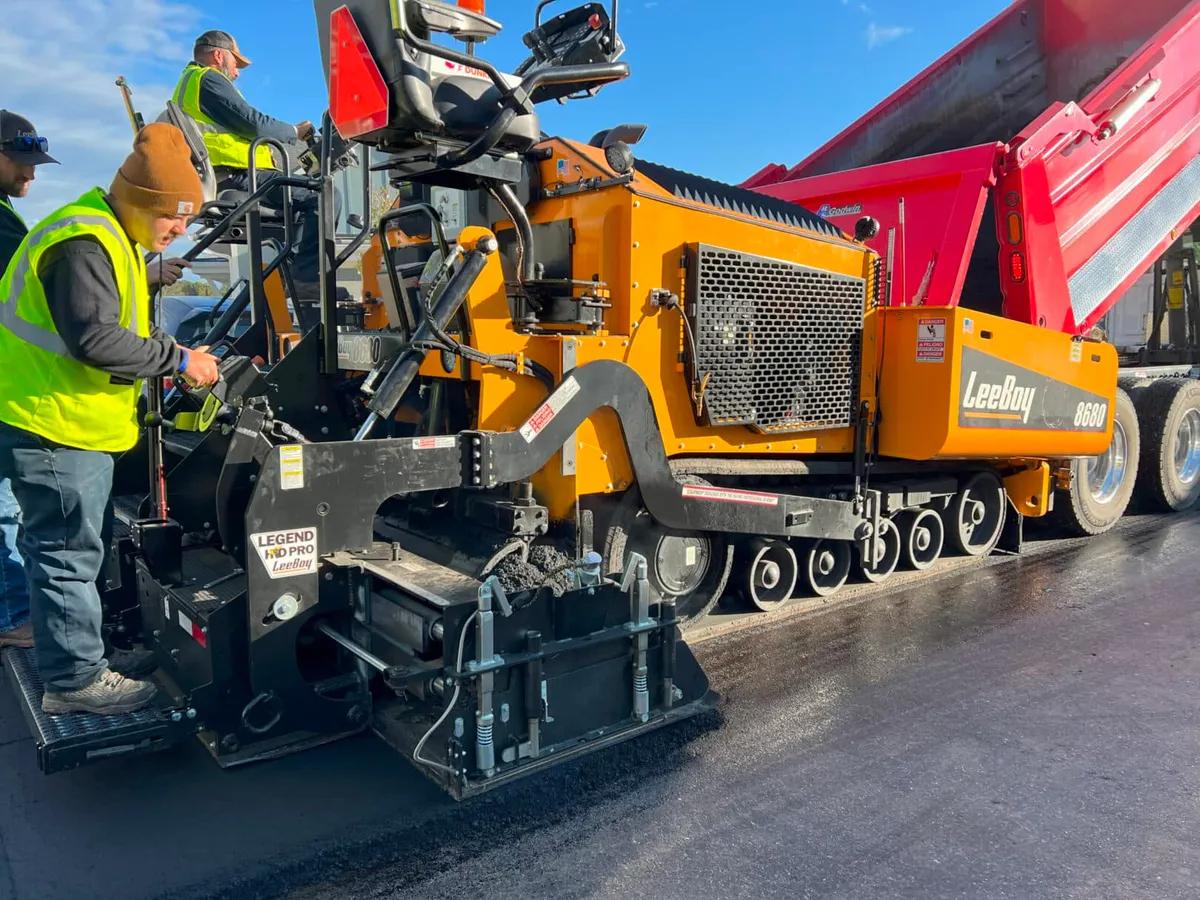
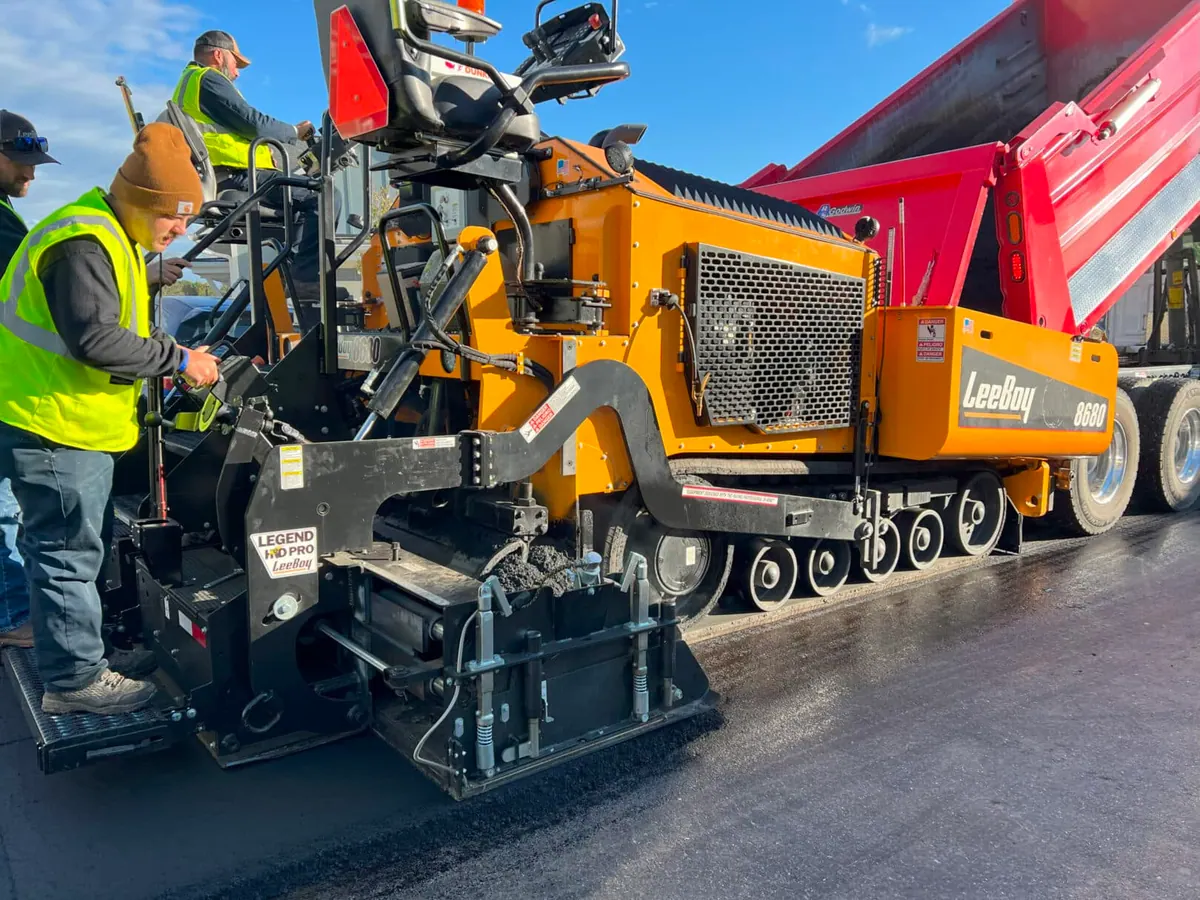
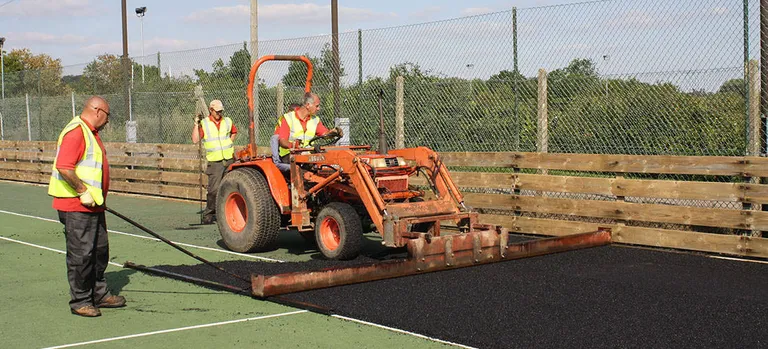
On courts that will receive acrylic, 5 cm of fine asphalt is laid; for thicker build-ups, 5–10 cm of binder course plus 5–8 cm of wearing course is preferred. After asphalt, a curing period of 10–15 days is mandatory; a covering applied without waiting cracks within a short time.
063 – 6 days
Surface covering application
Depending on the chosen system, primer, filler and colour coats are applied in sequence. Each layer is laid only after the previous one has dried. On EPDM and polyurethane systems the mix is prepared on site and cast in place with a trowel. Application temperature and humidity are decisive at this stage.
071 – 2 days
Line marking
White lines 5 cm wide, to TVF and FIVB standard, are set out in acrylic-based paint. The centre line, attack lines, service zone markings and boundary lines are applied with templates. Lines must be a light colour, distinct from both the surface and the free zone.
083 – 5 days
Posts, net and perimeter systems
Galvanised steel posts 2.55 m high are fixed on concrete anchors, positioned 0.50–1 m outside the sideline. The adjustable mechanism allows the net to be set at 2.43 m for men and 2.24 m for women. If perimeter fencing is required, 60 × 2.00 mm main posts are erected and 50 × 50 × 3.50 mm PVC-coated mesh is fitted.
092 – 3 days
Lighting and electrical infrastructure
LED floodlights are positioned so the calculated lux figure is achieved at every point of the court. Pole height and beam spread are chosen to prevent glare. The panel, cabling and earthing are completed; the lighting is commissioned and measured at surface level.
101 – 2 days
Dimensional check, testing and handover
Before handover the court is measured against the rule book, item by item: playing court 18 × 9 m, line width 5 cm, attack line 3 m from the centre line, net height 2.43 m for men and 2.24 m for women, with no more than 2 cm difference between the two ends. The surface is hosed to check for standing water. Every shortcoming found goes onto a written list, and no handover takes place until it is closed. The court is handed over with its maintenance instructions and warranty document.
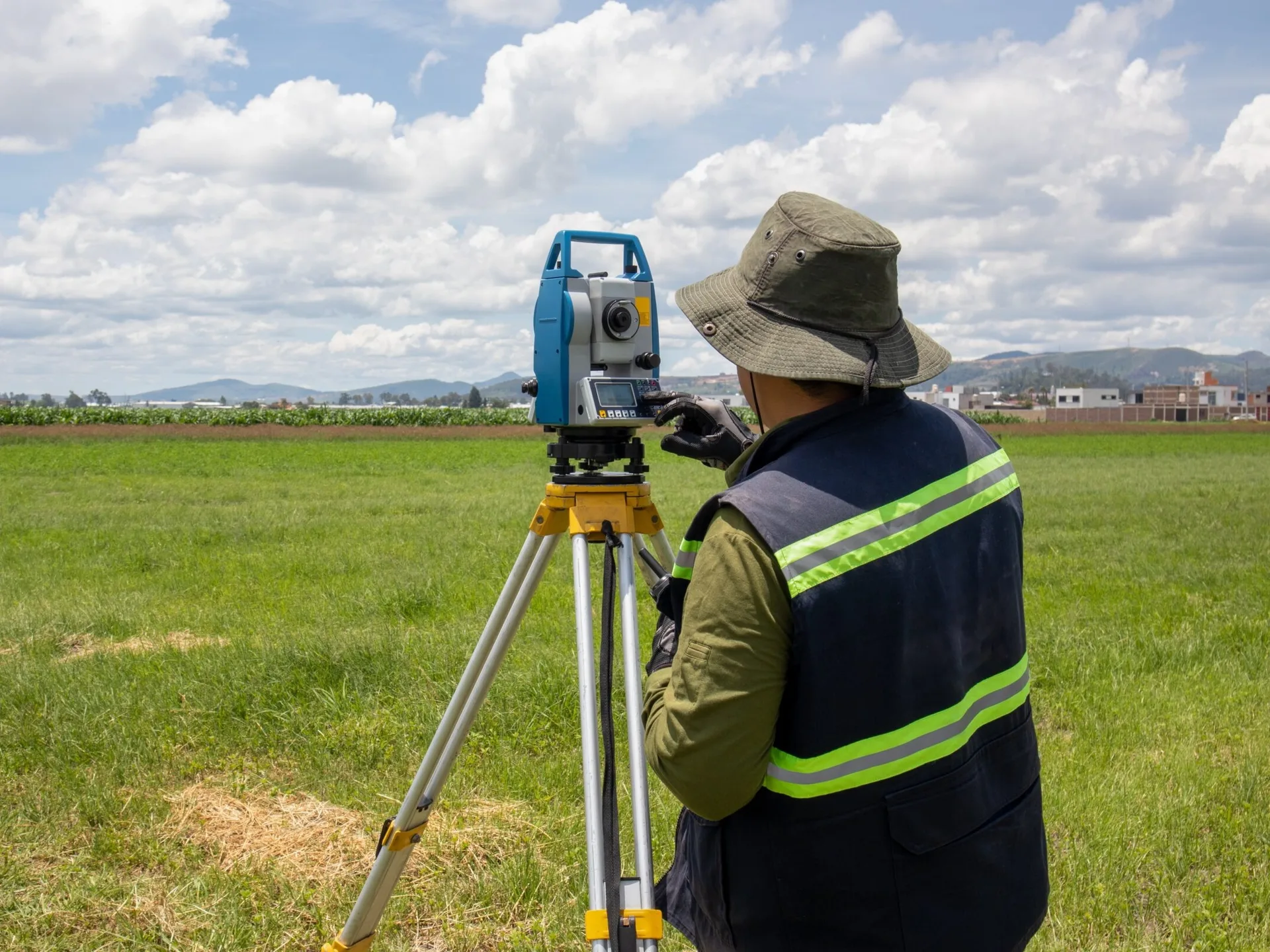
Total duration: outdoor court 25 – 30 days · indoor court 45 – 60 days
Tell us the location and size of your court; we will give you a survey date this week.
Volleyball Court Lighting, Perimeter Fencing and Net System
A volleyball court needs at least 300 lux at the playing surface for training and 2,000 lux for official competition. The perimeter fence should be a minimum of 4 m high, and the net posts 2.55 m high, set 0.50–1 m outside the sideline.
Court lighting
A lighting design starts from the lux figure; watts only tell you the energy consumption. The illuminance measured at the surface depends as much on pole height, beam spread and the number of luminaires as it does on the power of the fixture. Because tracking the ball in the air matters in volleyball, even light distribution and the prevention of glare are critical.
Training / school
at least 300 lux
Required illuminance
Typical solution
4 – 6 × 150-200 W LED
Pole height
6 – 8 m
Local competition
500 – 750 lux
Required illuminance
Typical solution
6 – 8 × 200-300 W LED
Pole height
8 – 10 m
Official competition (FIVB)
at least 2,000 lux
Required illuminance
Typical solution
Project-specific calculation
Pole height
10 m and above
Net system and posts
Posts should be 2.55 m high, preferably adjustable, and positioned 0.50–1 m outside the sideline. An adjustable mechanism lets the same court be used at both men’s (2.43 m) and women’s (2.24 m) height; on school and club courts this is a practical necessity. The net is 1 m wide and 9.5–10 m long, formed of 10 cm black square mesh. Along its top edge runs a 7 cm band of double-layer white canvas containing the elastic cable that holds the tension. The side bands measure 5 cm × 1 m and count as part of the net. The antennas are fibreglass rods 1.80 m long and 10 mm in diameter; their upper 80 cm is marked with 10 cm red-and-white stripes and defines the side limits of the crossing space.
Perimeter fencing and mesh
On outdoor courts a perimeter fence is effectively mandatory because it keeps the ball on the court. Common practice is 60 × 2.00 mm main posts, three rows of industrial tube rails and 50 × 50 × 3.50 mm PVC-coated mesh. Minimum height is 4.00 m; in windy areas and on courts next to a road it can be raised to 6 m. The posts are protected with one coat of cellulosic primer and two coats of RAL 6005 green.
Optional equipment
The following items sit outside the core scope and can be deferred to suit the budget: portable or fixed seating, referee stand, electronic scoreboard, windbreak netting, team shelters, court cover and ball-retention netting. None of them is required for the court to be usable — although on courts where matches will be held, a referee stand and a scoreboard are needed in practice.
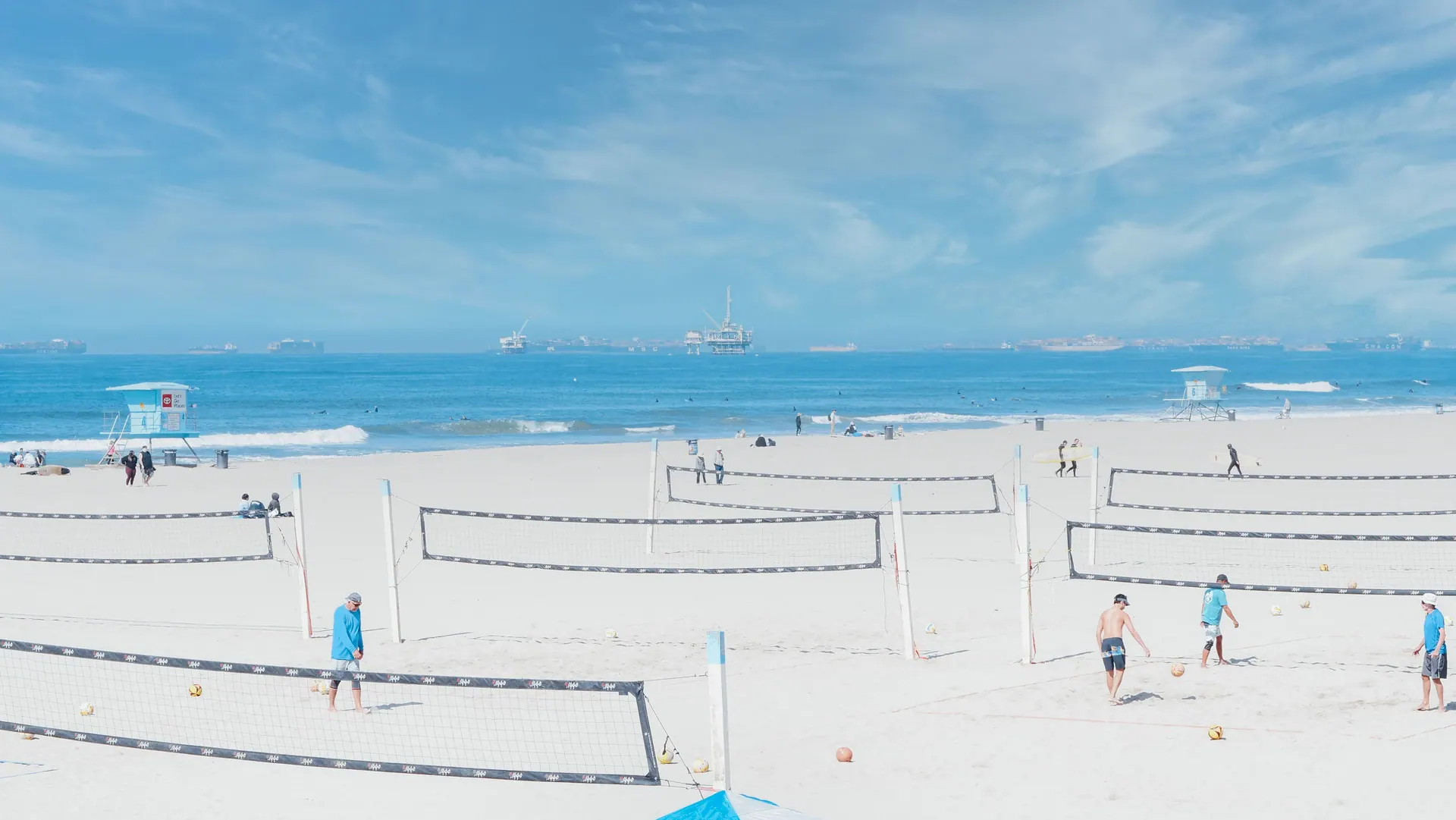
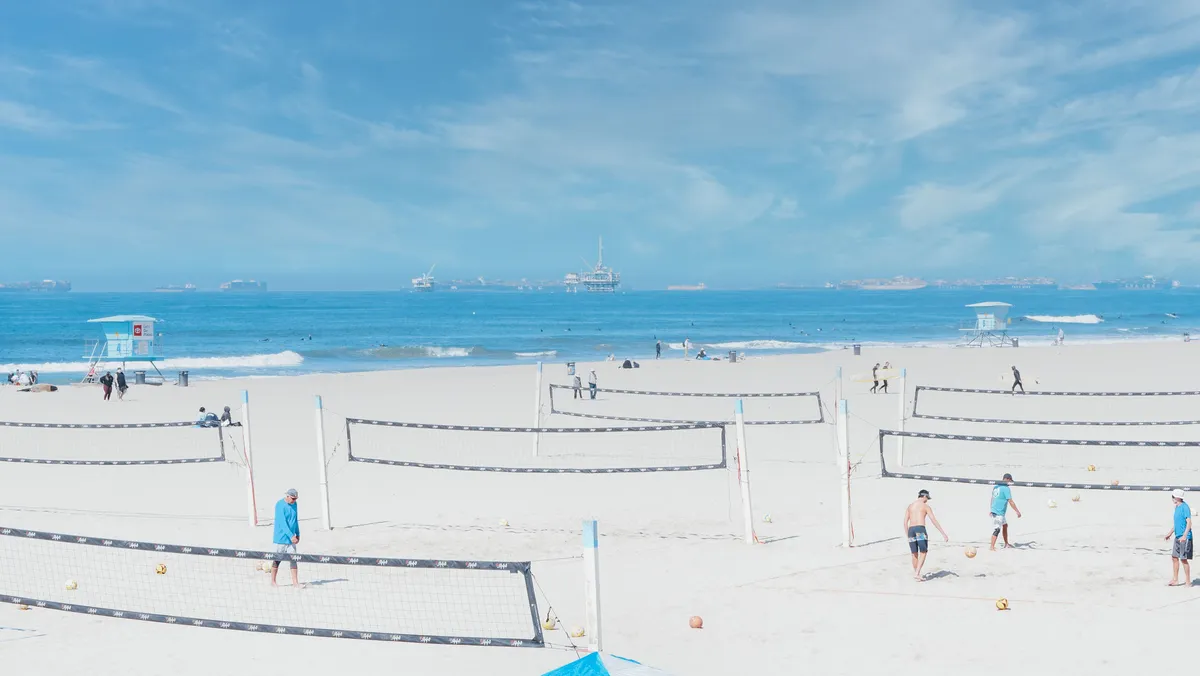
A beach volleyball playing court is 16 × 8 m — 2 m shorter and 1 m narrower than the indoor court. The free zone must be at least 3 m on every side. Net height is the same as indoor volleyball: 2.43 m for men, 2.24 m for women.
A beach volleyball court needs a completely different substructure from a hard-surface court. What decides the result is not the sand but the drainage underneath it.
Sand and drainage
Sand depth must be at least 40 cm; that is the minimum needed so a player landing from a jump never touches the hard base. The sand must be washed, screened, free of sharp edges and free of stones, with a grain size preferably in the 0.2–1 mm band. Sea sand is not used directly because it carries salt. Geotextile fabric is laid under the sand and a drainage layer beneath that, so rainwater is carried away instead of being held in the sand. Beach courts built without proper drainage stay unusable for days after rain.
The structure under the sand
From the bottom up the order is: compacted natural ground, 15–20 cm of drainage gravel, geotextile fabric, then 40 cm of sand. The geotextile does two jobs at once — it stops the gravel mixing into the sand and it lets water pass downwards. A kerb 20–30 cm high is run around the court; without it the sand spreads into the surroundings within the first year and the depth drops below 30 cm.
Differences in equipment
Net height is the same as indoors: 2.43 m for men, 2.24 m for women. The posts sit on concrete anchors buried in the sand and are padded. Unlike an indoor court, a beach court has no attack line and no centre line; it is bounded only by the four boundary lines, and those lines are formed with 5–8 cm wide coloured webbing rather than paint. The webbing is anchored at the corners, never left loose in the sand.
Differences from indoor volleyball
Item
Indoor volleyball
Beach volleyball
Playing court
18 × 9 m
16 × 8 m
Free zone
at least 3 m
at least 3 m
Total area
24 × 15 m — 360 m²
22 × 14 m — 308 m²
Attack line
Yes (3 m from the centre line)
None
Net height
2.43 / 2.24 m
2.43 / 2.24 m
Surface
Acrylic, hardwood, PVC, EPDM
Washed sand, min. 40 cm
Boundary lines
Painted
Coloured webbing and corner anchors
For hotel and holiday village projects a beach volleyball court is markedly more economical than a hard-surface court; because no asphalt or reinforced concrete slab is needed, the substructure cost drops.
Who will use the court, and how often, decides the surface system, the equipment list and the budget directly. Below are our recommendations for the six types of use we meet most often.
Schools and Ministry of Education projects
Space in school yards is usually limited. The Ministry of Education’s school-yard planning principles define the volleyball area as 9 × 18 m internally and 13 × 22 m overall, and recommend orienting the court north–south so the sun stays out of the players’ eyes. Because use is heavy and largely unsupervised, durability comes first; standard acrylic or cushioned acrylic is the most suitable answer.
Municipalities and public institutions
On public projects, compliance with the technical specification and documented material quality are decisive. Multi-purpose use is often requested; volleyball lines can be marked on the same surface together with basketball and tennis. In that case the line colours must be distinguishable from one another, and the rule requires the playing court and the free zone to be different colours.
Housing estates and residences
On courts inside housing estates, noise and balls escaping are the most frequent complaints. The height and position of the perimeter fence must be planned according to the court’s distance from neighbouring blocks. Where space is tight, the free zone is narrowed to preserve the playing court. Evening use is common, so the lighting design must be calculated from the outset.
Sports clubs and academies
On courts used for regular training, impact absorption comes to the fore. Cushioned acrylic or EPDM/tartan systems are preferred because they protect the athlete’s joints. Adjustable net posts matter as well, so different age and gender categories can train on the same court.
Hotels and holiday villages
In tourism facilities a beach volleyball court is both more economical than a hard-surface court and better received by guests. At seaside properties, galvanised or stainless equipment markedly extends service life because of salt and wind.
Volleyball courts are a frequent choice for staff recreation grounds because they need little space and cost little to maintain. Since shift patterns make evening use common, lighting matters as much as the court itself.
Multi-purpose court: volleyball, basketball and tennis together
Lines for more than one sport can be marked on a single surface. The most common combination is volleyball plus basketball; where space allows, tennis is added too. This raises the return per square metre and is especially favoured on school and housing-estate projects. Two points need care: the line colours must be distinguishable from one another, and the net posts should sit in removable ground sockets so they can be lifted out when volleyball is not being played, freeing the space for the other sports.
With regular maintenance an acrylic volleyball court lasts 8–10 years, an EPDM/tartan surface 12–15 years, and an indoor hardwood floor 20–30 years. Routine annual maintenance runs at around 15.000 – 30.000 ₺.
Maintenance is the cheapest investment there is in the life of a court. A simple clean and a line refresh once a year push the need for resurfacing back by years.
Year-by-year maintenance schedule
Ongoing
Sweeping leaves, soil and coarse dirt
Weekly in autumn in particular
Yearly
General wash with pressurised water
Pressure must not damage the surface
Yearly
Line inspection and refresh if needed
Faded lines break competition compliance
Yearly
Net, post and anchor inspection
A loose anchor is a safety risk
Every 2–3 years
Wear inspection, local repair
Small cracks close with early intervention
Every 5–8 years
Top-coat renewal on acrylic surfaces
Enough if the lower layers are sound
Every 10+ years
System assessment
Decision: resurface or rebuild
Resurface or rebuild?
The decision depends on the condition of the substructure, not the top covering. If the concrete or asphalt base is sound, the worn covering can be stripped and reapplied — that comes out markedly below the cost of building from scratch. But if there is settlement, wide cracking or standing water in the base, surface renewal reproduces the same problems within a short time. In that case you have to go down to the substructure. This is the first thing we look at during the survey.
What happens if maintenance is neglected?
The most common chain is this: drainage blocks, water collects on the surface, the covering lifts through freeze–thaw cycles, the lifted surface cracks, and water entering the crack separates the lower layers. Past that point local repair no longer helps and the whole covering has to be renewed. A drainage check once a year prevents the entire chain.
Start-of-season and end-of-season checks
At the start of the season: drainage gratings clear, lines legible, net tension and post anchors tight, every lighting fixture working. At the end of the season: wash the surface with pressurised water, remove any moss and leaf build-up, and take down the net and antennas to store them indoors. A net left tensioned through the winter loses the elasticity of its weave and becomes unusable within a season; taking it down is a five-minute job.
KATİSAN is based in Ankara and builds outdoor and indoor volleyball courts across Türkiye. We carry the work from the subbase to the net system under one roof, and run the process from survey to handover with our own crew.
Every quotation is tied to a written specification, item by item. Which layer is applied at how many centimetres, which equipment is included and which is optional — all of it is in the contract. The reason is simple: in sports facility construction almost every dispute comes from a scope that was never written down clearly at the start.
We do not use intermediate subcontractors. Subbase, surface, posts and net, and lighting are gathered into a single contract; when something goes wrong there is no argument about whose responsibility it is. This is not the usual way the industry works — most firms lay the surface themselves and hand lighting and fencing to a subcontractor. The usual result: the lighting pole is erected after the surface is finished, and the new covering is drilled through in its first week.
The survey is free and commits you to nothing. We come to the site and measure the ground condition, the slope, the existing drainage and the free zone on the spot. We leave you the measurement results, the systems that can be applied, and the cost range for each one in writing. Even if you do not work with us, that report stays with you and helps you compare the other quotations you receive.
Contract with a written specification
Layer thicknesses, material properties and the equipment list are written out item by item.
Transparent cost
Our price ranges are published openly on this page; the quotation is consistent with them.
TVF and FIVB standards
Dimensions, lines and the net system follow the official rule book.
Nationwide application
Based in Ankara, we build courts in all 81 provinces.
A figure given without seeing the site is a guess. The survey is free and commits you to nothing.
Volleyball Court Construction in Ankara and Across Türkiye
Volleyball court construction in Ankara
We are based in Ankara, so for projects inside the city the survey can usually be done within the same week. School yards, shared social areas in housing estates, municipal sports facilities and corporate recreation grounds are the project types we build most often. Because of Ankara’s winters, seasonal planning matters for asphalt and acrylic work; spring and autumn are the most suitable periods.
Projects outside Ankara
We build across Türkiye. On out-of-town projects, haulage and crew accommodation are quoted as separate items and stated up front; nothing is added later. For distant provinces the survey is planned according to the size of the project.
How we work on out-of-town projects
Three items decide the cost on an out-of-town project: hauling the material to site, accommodating the crew, and whether the machinery can be sourced locally. We settle all three during the survey and write them into the quotation as separate lines. On cast-in-place systems such as EPDM and polyurethane in particular, if the machinery is not available locally, haulage alone can reach five per cent of the total — we write that down at the start rather than reporting it later as a surprise.
Which season should the work be done in?
Acrylic and polyurethane systems require the surface temperature to stay above 10 °C during application, and relative humidity should not exceed 85 per cent. In Central Anatolia these conditions hold reliably from April to June and from September to October. In July and August, when surface temperature passes 50 °C, acrylic can dry too fast and leave marks; in that period application is moved to the early morning. Through the winter, subbase and structural work continues — only the surface covering waits.
Districts of Ankara we serve
Çankaya
Keçiören
Yenimahalle
Etimesgut
Sincan
Mamak
Altındağ
Gölbaşı
Pursaklar
Polatlı
Kahramankazan
Elmadağ
Akyurt
Çubuk
Visual reference
Volleyball Court Types and System Views
Frames showing the court types and systems described on this page: indoor net systems, acrylic and EPDM surfaces, beach volleyball sand bases, post and antenna details. Each frame is captioned with the system it shows; click to enlarge.
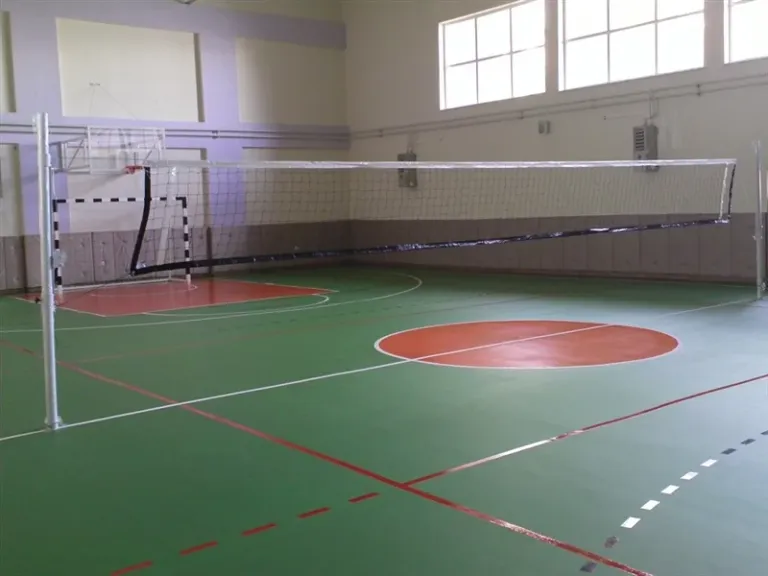
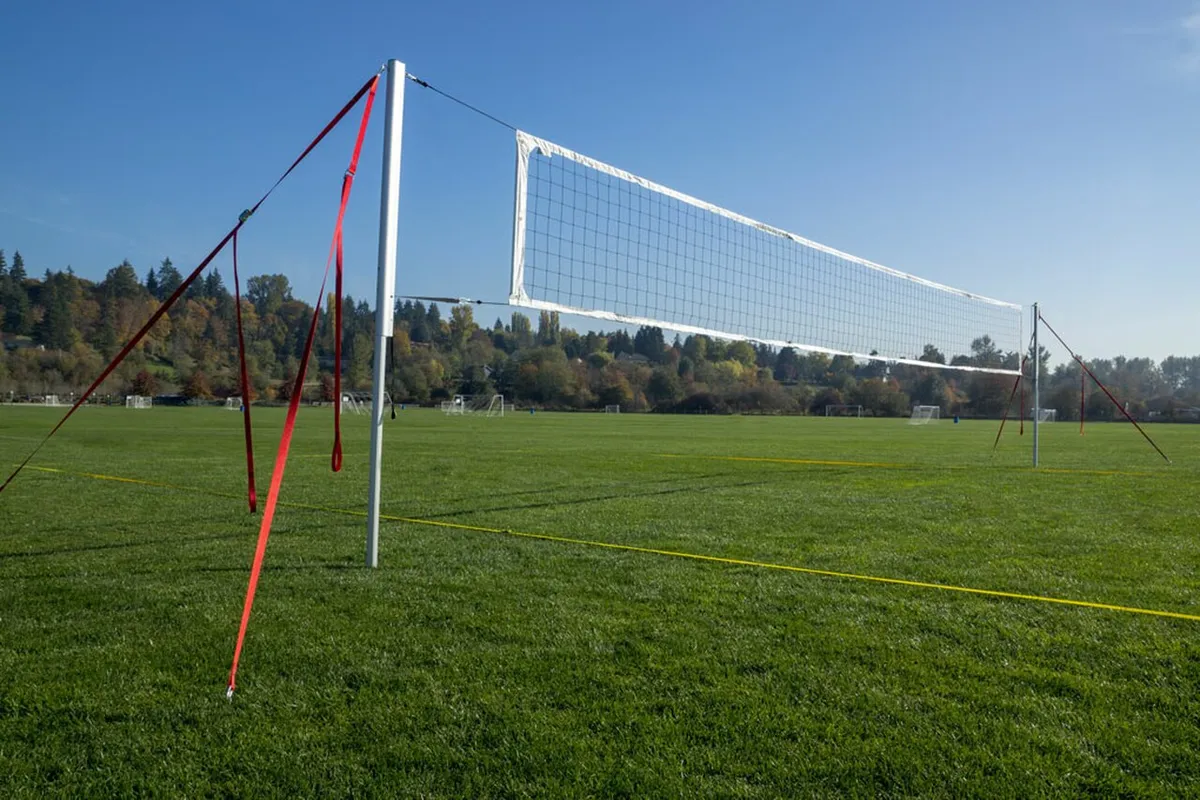
Two volleyball courts side by side in an indoor hall, net systems installedVolleyball net post and net systemOutdoor volleyball court with an EPDM surface and net systemIndoor volleyball court — net, centre line and free zoneOutdoor volleyball net, posts and antennasIndoor volleyball posts and net systemBeach volleyball courts — sand surface and net systemsMembrane-roofed indoor court with an acrylic surface
Court and hall footage
Play on an indoor volleyball court
Court installation work in an indoor hall
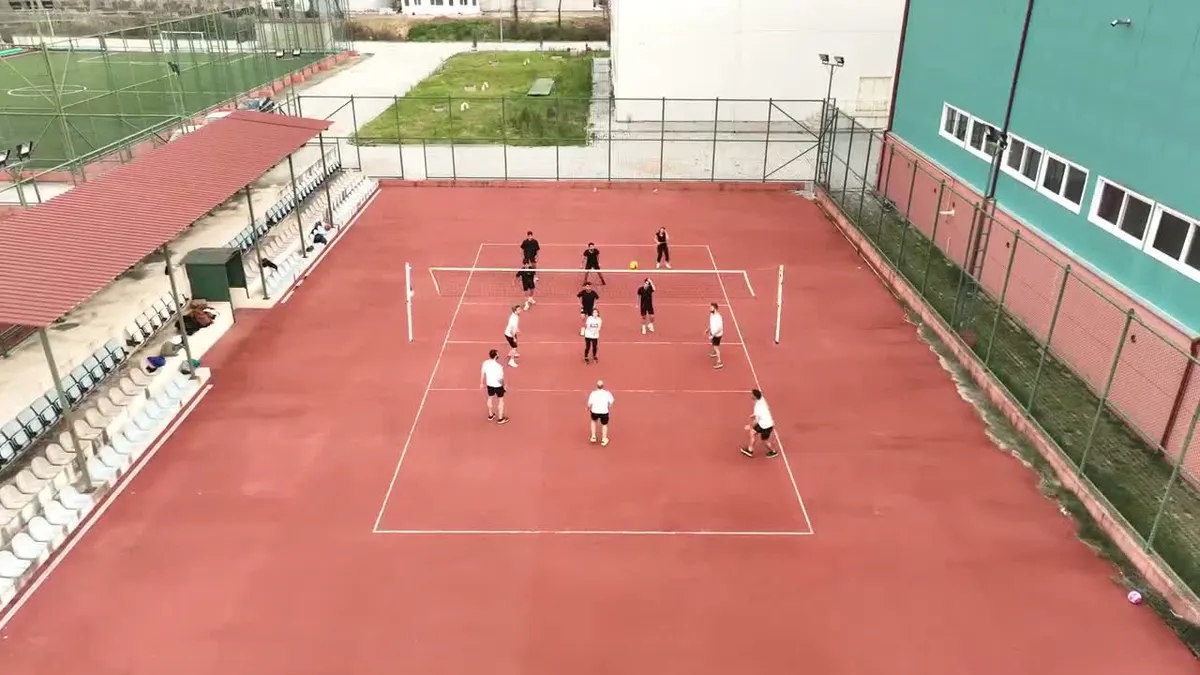
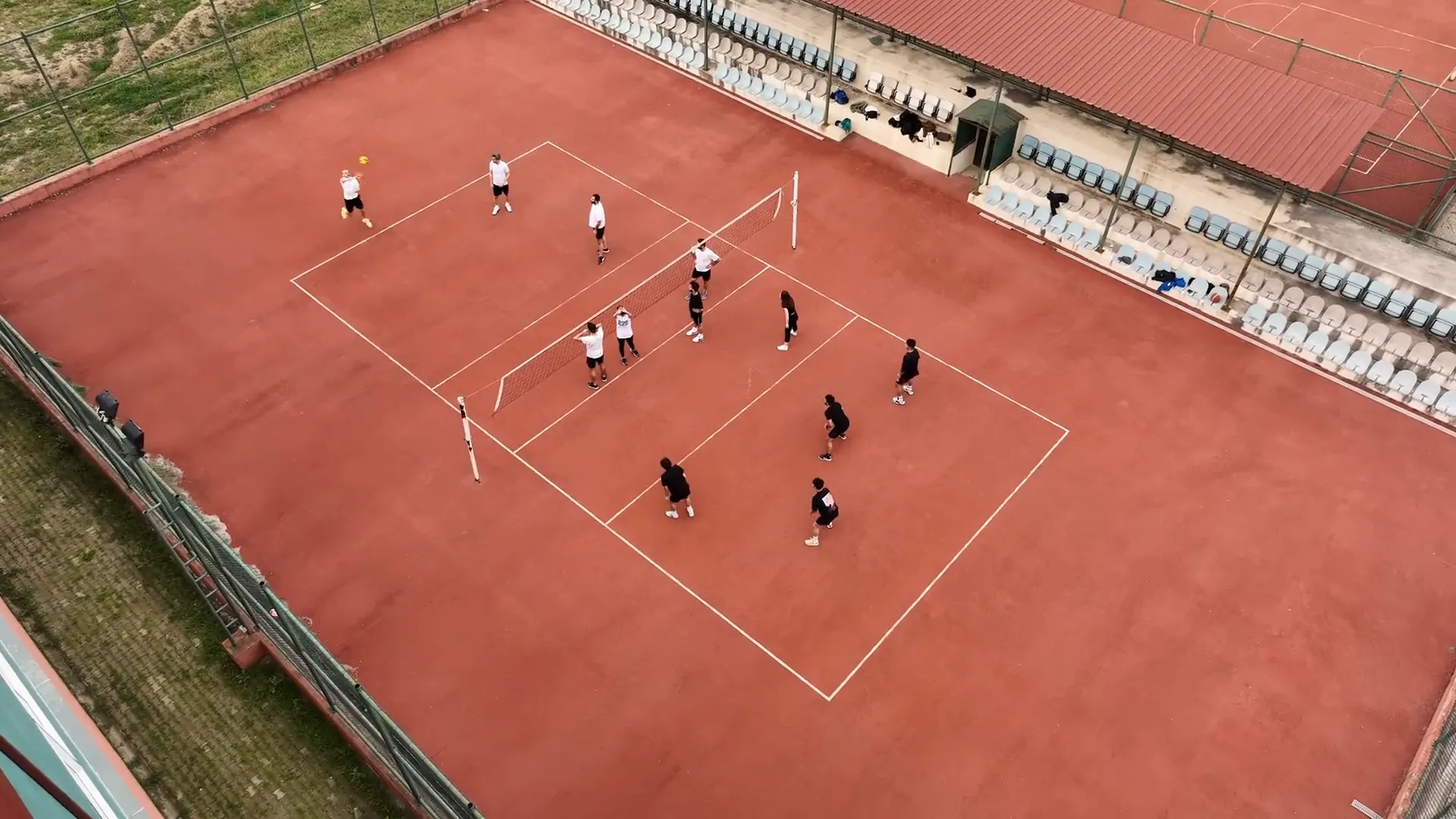
Outdoor volleyball court — aerial view
Application video
Questions
Frequently Asked Questions About Volleyball Court Construction
The questions we are asked most often during the quotation stage, with short answers. If you cannot find what you are looking for, you are welcome to ask the same question by phone.
Cost, schedule and payment 8
How long does it take to build a volleyball court?
An outdoor court is completed in 25–30 days, an indoor court in 45–60 days. On courts where acrylic is laid over asphalt, the 10–15 day curing period is part of that calendar and cannot be shortened. Weather and permit processes can extend it.
What does a volleyball court cost in 2026?
The turnkey unit cost of an outdoor court ranges from 190 – 3.300 ₺/m² depending on the surface system chosen. For a 360 m² reference court the total comes to 270.000 – 400.000 ₺ in the economy scenario and 1.100.000 – 1.700.000 ₺ in the professional scenario. The final figure is set in a written quote after the site survey.
What does annual maintenance cost?
Budgeting 15.000 – 30.000 ₺ a year is enough for routine maintenance. That covers cleaning, line refreshing, checks on the net and anchors, and small repairs. Renewing the top coat every 5–8 years is a separate item.
Can the work be done in winter?
Acrylic and polyurethane applications are sensitive to temperature and humidity. As a general rule, surfacing is not applied when the ambient temperature is below 10 °C or rain is expected. Excavation, drainage, perimeter beams and structural work can proceed through the winter, with surfacing planned for spring. In continental climates such as Ankara’s, spring and autumn are the best windows.
What exactly does turnkey include?
Survey and design, excavation and drainage, subbase laying, perimeter beam, base application, surface covering, line marking to TVF/FIVB standards, and net post and net installation form the core scope. Lighting, perimeter fencing, seating and scoreboards are optional items and are shown separately in the quote. What is included is written item by item in the specification attached to the contract.
How does the quotation process work?
First we take the site details by phone or through the form: location, approximate dimensions, the condition of the existing ground and the intended use. Then we carry out a site survey. After the survey we prepare an item-by-item written quote and technical specification. The quote is consistent with the price bands published on this page.
What does the warranty cover, and what does it not?
The materials and workmanship warranty covers delamination, blistering, premature colour loss and cracks arising from the application. Outside the scope: mechanical damage from sharp or pointed objects, use of unsuitable cleaning chemicals, vehicle traffic on the court, and force majeure such as earthquake or flood. The warranty period and its scope are written into the contract.
How is payment made?
Payment is made in instalments tied to the work programme: a deposit on signing, an interim payment when the subbase is complete, and the balance when the surfacing is finished and at handover. The amounts and instalment ratios are fixed in the contract. We do not ask for the full sum up front; you pay as the work progresses.
Dimensions and standards 6
How many square metres should a volleyball court be?
The playing court is 18 × 9 m. Because a free zone of at least 3 m is required on every side, the total is planned at 24 × 15 m — that is 360 m². On international competition courts the free zone widens to 5 m at the sidelines and 6.5 m at the end lines, bringing the total to 616 m².
How high is a volleyball net?
Net height is 2.43 m for men and 2.24 m for women. The height is measured at the centre of the playing court; both ends must be equal and must not exceed the stated value by more than 2 cm. An adjustable post system allows the same court to serve both categories.
What ceiling height does an indoor volleyball court need?
There must be at least 7 m of clear height above the playing court. For FIVB World and Official Competitions that figure is 12.5 m. "Clear" includes light fittings, roof trusses and ventilation ducts — which is why the figure that counts is not the roof level but the unobstructed playing space.
How many lux should volleyball court lighting be?
Lighting is measured in lux, not watts. A training court needs at least 300 lux over the playing area, local competitions 500 lux, and FIVB World and Official Competitions 2,000 lux. Watts only describe the energy a fitting draws; two luminaires of the same wattage can produce very different illuminance on the court. The lux figure and the measuring point should be stated in the quote.
Can the free zone be narrowed?
Where space is short the free zone can be narrowed; the playing court cannot. Below 3 m the court loses competition compliance but remains acceptable for training and school use. Below 2 m player safety becomes a concern; in that case there must be no hard objects, posts or walls around the court.
Why does court orientation matter?
On outdoor courts the long axis is set north–south. In an east–west layout the sun falls directly into players’ eyes morning and evening, spoiling sight of the serve and the block. Ministry of Education schoolyard guidance recommends the same orientation. The decision is made at the design stage and cannot be changed afterwards.
Surface and technical detail 6
Which surface system should I choose?
For outdoor courts in moderate use, standard acrylic is enough. On club and school courts used for regular training, cushioned acrylic or EPDM/tartan with higher impact absorption is preferred. Indoors, hardwood, PVC or polyurethane are suitable. The choice sits at the intersection of location, intensity of use and budget.
How many years does an acrylic surface last?
With regular maintenance, 8–10 years. For cushioned acrylic this rises to 10–12 years, and for EPDM/tartan surfaces to 12–15 years. An indoor hardwood floor lasts 20–30 years and can be sanded and re-varnished repeatedly. The biggest factor in service life is a correctly built subbase and working drainage.
How much sand does a beach volleyball court need?
The sand layer must be at least 40 cm deep — roughly 120 m³ of sand for a 22 × 14 m court. The sand must be washed, screened and free of sharp-edged grains; river sand and construction sand cannot be used. Without a drainage layer and geotextile beneath it, the sand mixes into the soil over time and the depth is lost.
Can lines be painted directly onto concrete?
Technically yes, but it does not count as a volleyball court. Bare concrete has no impact absorption; the load of jumping and landing goes straight into the knees and ankles. Its friction is uneven, it becomes slippery when wet and it cracks over time. Concrete is not a surface system — it is the base a covering is applied to.
Why does floor moisture matter indoors?
Hardwood and PVC systems change dimension with moisture. If the relative humidity of the concrete substrate is not measured before application, hardwood swells and PVC blisters. A moisture reading should be taken beforehand and a vapour barrier laid if needed. Skip this step and the problem appears in the first heating season — and the remedy is lifting the floor.
What happens if drainage is not installed?
If surface water is not carried away from an outdoor court, water collects beneath the surface. In winter the freeze-thaw cycle pushes the covering up from below and cracks it; acrylic systems blister and EPDM loses its bond. Done properly, the court is given a fall of 0.5–0.8 per cent and a drainage line is run around it. Drainage is far cheaper than the surface — but neglected, it takes the whole surface with it.
Scope and application 6
Is a permit required to build a volleyball court?
It depends on the zoning status. For outdoor courts, most municipalities accept a simple building permit or authorisation. Indoor courts and facilities with seating require a municipal building permit; in some cases approval from the Ministry of Youth and Sports is also required. We clarify what your area requires together during the survey.
Can our existing court be renovated?
If the concrete or asphalt base is sound, the worn covering can be stripped and replaced. That comes in noticeably below the cost of building from scratch. But if the base has settled, has wide cracks or holds water, a surface-level renewal is not a lasting solution and the subbase has to be addressed. This is the first thing we check during a survey.
Can a volleyball court be built in a schoolyard?
Yes. Ministry of Education schoolyard guidance defines the volleyball area as 9 × 18 m internally and 13 × 22 m externally, and recommends orienting the court north–south. Where space is tight, the playing court is kept and the free zone narrowed; that is an acceptable solution for lessons and training.
Can a multi-purpose court be built?
Yes, and it is a frequent choice on school and residential projects. The most common combination is volleyball plus basketball; where space allows, tennis is added too. Two points matter: the line colours must be distinguishable from one another, and the net posts should sit in removable sockets so they can be lifted out when volleyball is not being played.
Do you work in every province of Türkiye?
Yes. We are based in Ankara and build across the country. On out-of-town projects, haulage and crew accommodation are quoted as separate items from the start; nothing is added later.
What if we want to add seating later?
Seating is positioned outside the free zone, at least 3 metres from the playing court. Indoors, the weight of the stand acts on the load-bearing system, so it has to be in the structural calculation from the start; adding it later means strengthening the steel frame. Outdoors, prefabricated seating options are more flexible.
If your question is not on the list, write it in; our technical team will answer in writing within 24 hours.